
The failure to promptly manage vehicles burned during the Gen-Z movement risks long-term, severe impacts on health and the environment due to toxic chemicals and ash.
Prakashman Amatya (72) of Dattatraya, Bhaktapur, has little understanding of the Gen-Z movement that took place last September. However, that very movement on September 8 and 9 landed him in the hospital.
Amatya owns a small shop selling worship materials near Dattatraya Square. On September 9, he was at his shop from 6:00 a.m. to 1:00 p.m. Starting at 10:00 a.m. that morning, the sky around Bhaktapur Durbar Square was suddenly covered in thick black smoke.
Vehicles were set on fire near the Bhaktapur District Administration Office, the police office, and surrounding areas of Bhaktapur Durbar Square, locations just 350 meters from his shop. The smoke from the burning vehicles and structures made the surrounding environment hazy, filling the ancient temple-filled city of Bhaktapur with smog. Amatya, who has suffered from epilepsy for years, found himself trapped in the suffocating smoke.
He was neither a participant in the protests nor particularly informed about the movement. The severe smoke and pollution spreading around his area made it difficult for him to breathe, and he eventually feel semi-conscious. His wife, Brinda, says, “He already had some respiratory issues but this was the first time he became so serious that he lost consciousness. If we had known there would be so many fires and so much smoke, we wouldn’t have sent him to the shop that day.”
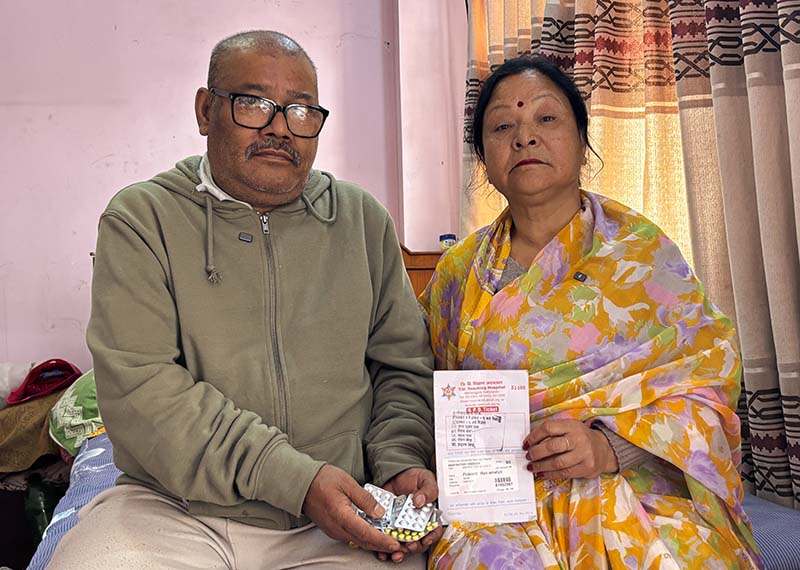
Prakashman was taken to the T.U. Teaching Hospital in Maharajgunj by his family the following morning. He was not the only one to visit the hospital in such a state. Doctors report that on the day of the movement and the day after, there was a significant increase in the number of patients complaining of burning eyes, nasal congestion and respiratory issues.
According to Dr. Niraj Bam, a senior chest specialist at T.U. Teaching Hospital, the facility, which typically sees about 200 patients daily, saw nearly 280 patients in the days following the event. He notes that the impact of the September 8 and 9 movement led to a surge in respiratory patients in both the OPD and emergency wards until September 14.
Those seeking treatment included young and elderly protesters, security personnel and residents of the affected areas. Dr. Niraj mentioned that colleagues from other hospitals in the valley also reported a similar rise in patients with these symptoms.
“The black smoke produced by burning petroleum products contains carbon particles, ozone gas and other greenhouse gases that cause everything from airway allergies to a sensation of suffocation,” he explains. “Many such patients are still taking medication and returning for follow-up visits.”
More than 12,000 vehicles were burned nationwide during the Gen-Z movement, which claimed 76 lives, with 6,800 of those vehicles burned in Bagmati Province alone. The smoke and toxic chemicals released from these fires caused an increase in hospital patients with respiratory, eye and skin problems. Furthermore, the remains of these vehicles have not been managed in a timely manner, creating a risk that chemicals and ash will cause long-term severe impacts on health and the environment.
According to the Department of Environment, air pollution in the Kathmandu Valley spiked in September. Environmental Inspector Govinda Lamichhane noted that despite scattered rainfall across the valley starting September 5, the fires during the protests pushed pollution levels higher.
September is typically considered a low-pollution period due to the monsoon rains. However, data from the Department of Environment shows the opposite trend. On September 6, the PM2.5 level at the Ratnapark station was 13.2. As the movement began on September 8 and 9, and continued into the 10th, these levels rose to 20.2, 25.8 and 33.0, respectively, even while the valley experienced intermittent rain.
“This is data from just one location. Pollution could be even higher in areas where the major fires occurred,” says Inspector Govinda. “Satellite images from those days also indicate significant fire activity in Nepal, particularly within the valley.”
According to the World Health Organization, health risks begin to increase when PM2.5 levels exceed 15 micrograms per cubic meter over a 24-hour period, a level classified as unhealthy air.
An investigation by the Nepal Investigative Multimedia Journalism Network (NIMJN) has revealed that petroleum products were used to set fire to structures including Singha Durbar, the Parliament Building, and the Supreme Court during the movement. The fires at these sites, as well as at other private buildings and commercial establishments ignited on the 9th, were not extinguished until the 11th.
Govinda notes that the pollution generated from the burning of buildings and vehicles at that time has still not been measured. He emphasizes the need for a study on the pollution released from the simultaneous burning of over 12,000 vehicles and its subsequent impact on the environment and human health. “The toxic chemicals released when vehicle burns are even more dangerous,” he says. “Even the ash alone falling onto the soil can prevent anything from growing there.”
Impact of toxic gases and chemicals
When vehicles burn, materials such as rubber, plastic, petrol, batteries, iron, wires and paint are incinerated. This process emits harmful gases and chemicals, including carbon dioxide, carbon monoxide, nitrogen oxides, sulfur dioxide and lead.
Prof. Daniel Tuladhar of the Department of Mechanical Engineering at Kathmandu University explains that these gases mix with air, water and vapor, affecting both the environment and human health in the short and long term.
According to the “Report on Damage Assessment of Public Property, Physical Structures, and Private Establishments and Reconstruction Plan for Public Structures, 2026,” 12,659 vehicles were burned during the protests on September 8 and 9, 2025.
Research indicates that when water is used to extinguish fires in burning vehicles, substances like petrol, plastic, rubber, oil, wires, paint and batteries mix with the water to form various toxic chemicals.
A 2024 study published in the journal Science of the Total Environment, titled “The Ecotoxicity and Mutagenicity of Fire-Water Runoff from Small-Scale Furnishing Materials Fire Tests”, refers to this polluted runoff as “fire-water runoff”. The study shows that it releases toxic gases and chemical substances such as carbon monoxide, sulfur dioxide, nitrogen oxides, benzene, volatile organic compounds and polycyclic aromatic hydrocarbons. Furthermore, the release of metals like lead, copper, zinc and cadmium, along with toxic organic chemicals like toluene, styrene, naphthalene and formaldehyde, can destroy soil fertility and soil microorganisms.
The smoke generated from this increases the risk of everything from lung issues to cancer in the long term. While no study has been conducted in Nepal to determine exactly how many chemicals were produced by so many vehicles burning simultaneously, a 2006 study published in the journal Chemosphere titled “Emissions from an Automobile Fire” provides a baseline. According to the study, a single burning four-wheeler produces 265 kg of carbon dioxide, 6.5 kg of carbon monoxide, 0.17 kg of hydrogen cyanide, 1.4 kg of hydrogen chloride, and 0.54 kg of sulfur dioxide.
Based on this study, looking only at the 1,676 four-wheelers burned on a single day (September 9), the volume of chemicals emitted includes 443,875 kg of carbon dioxide.
Similarly, 10,887.5 kg of carbon monoxide, 284.75 kg of hydrogen cyanide, 2,345 kg of hydrogen chloride, and 904.5 kg of sulfur dioxide were produced.
According to research, these gases affect human health by damaging the lungs and brain, reducing oxygen in the body by dissolving into blood hemoglobin, and causing irritation to the eyes, skin and respiratory tract.
In the environment, these emissions contribute to climate change by producing greenhouse gases, increasing ozone pollution, causing aquatic pollution if mixed with water, proving toxic to wildlife, triggering acid rain, and reducing the fertility of plants and soil. Sudeep Thakuri, an Associate Professor at the T.U. Central Department of Environmental Science and an environmental researcher, states that a car contains about 115 kg of polymers (plastic materials), about 50 kg of petrol and oil, and nearly 100 kg of other plastics, totaling about 200 kg of combustible materials that ultimately disperse into the air.
“Therefore, with 6,000 of the 12,000 vehicles burning in the Valley alone, it is natural for hospital admissions to increase,” Sudeep says. “However, that is only the immediate problem. No study has been conducted on when or how long-term effects will manifest but the impact will be felt more significantly later than it is now.”
According to the State of Global Air, 41,000 people die annually in Nepal from diseases caused by air pollution. Environmentalist Bhushan Tuladhar states that protesters who were directly involved in the burning of thousands of vehicles in a single day could be the most affected. He notes that while the immediate effects were seen in their eyes, skin and breathing, that full day of exposure to pollution could lead to various diseases in the long term.
Electric vehicles were also burned that day. He explained that when such vehicles burn, lead particles from lead-acid batteries mix with the smoke. If these enter the body, they can cause memory loss, kidney damage and affect the nervous system. “Therefore, that day’s movement resulted in nothing but loss from every perspective,” Bhushan says.
Management remains uncertain
In 2018, environmental advocate Padam Bahadur Shrestha filed a writ petition in the Supreme Court against 23 ministries and agencies, including the Office of the Prime Minister and Council of Ministers, demanding the management of abandoned and non-functional government vehicles. In 2020, the court ruled in his favor. Subsequently, a committee was formed to collect data and manage government-owned vehicles and other junk materials. However, the damaged vehicles were neither repaired nor reused; they simply rotted where they were parked.
Now, the vehicles burned in September have been added to that list. Thousands of vehicles burned across the country are still left in fields, office compounds, parks, roads and public spaces. Environmentalists emphasize the urgent need to manage these vehicles in appropriate locations. “We must now focus on managing the objects that have already been burned,” says environmentalist Bhushan. “Instead, those materials are being dumped on roads, in parks and in bushes, which is creating another set of problems.”
-1775730543.JPG)
Experts emphasize that the ash resulting from these vehicle fires must also be properly managed. This ash is so toxic that nothing can grow where it settles. Therefore, environmental researcher Sudeep suggests that it should be collected and buried in a designated area far from water sources. He warns, “In partially burned vehicles, there is a risk that metals and remaining petrol could wash into sewers and eventually reach rivers when it rains.”
Under the leadership of the Ministry of Urban Development, burned vehicles from the Valley are being collected in the parking lot of the Parliament Building in New Baneshwor. However, researchers point out that there is a drinking water tank nearby in Baneshwor, posing an environmental and health risk. Environmentalist Bhushan Tuladhar says, “When it rains, the ash from burned vehicles, leftover petrol, and other metals can be washed away and absorbed into the soil. Since the water tank is nearby, there is a risk of seepage. Therefore, this management needs to be completed quickly.”
The respective ministries are responsible for managing their own burned government vehicles, with the Ministry of Urban Development providing support. According to Ministry Spokesperson Narayan Prasad Mainali, completely burned vehicles from 17 ministries and 8 departments have been collected and are currently stored at the Federal Parliament Building in New Baneshwor.
However, he notes that the respective ministries are delaying the process of either moving them to a proper location or putting them up for auction. He explains that, so far, only three agencies have completed the de-registration (record removal) process; six months later, 21 ministries have yet to submit their de-registration details to Urban Development. “The auction process can only begin once the de-registration from all ministries is received,” he says.
-1775730541.JPG)
The government has not yet taken any initiative regarding the management of vehicles burned outside the Valley. In the compound of the Bagmati Provincial Ministry of Physical Infrastructure Development in Makawanpur, 10 vehicles, including two burned electric vehicles, remain parked in a corner. According to the Ministry’s Information Officer, Vasudev Dahal, although a committee was formed for their management, the de-registration process has not yet been completed. “It is impossible to say when it will happen,” he says. “The process is likely just very tedious.”
Bhim Prasad Dhungana, President of the Municipal Association of Nepal and Mayor of Neelkantha Municipality in Dhading, states that while local levels are making efforts, management is still pending in many places. He says, “The government assigned responsibility to one agency for the Valley, but it failed to address the issue for the provincial and local levels.”
Professor Rejina Maskey of the T.U. Central Department of Environmental Science notes that, from an environmental impact perspective, burned vehicles in districts outside the Valley could cause even greater damage. She explains that the ash from the vehicles can reach nearby fertile farmland or water sources, posing a risk of completely depleting soil fertility.
In collaboration with Report for the World. Please adhere to our republishing policy if you'd like to republish this story. You can find the guidelines here.


Comments