
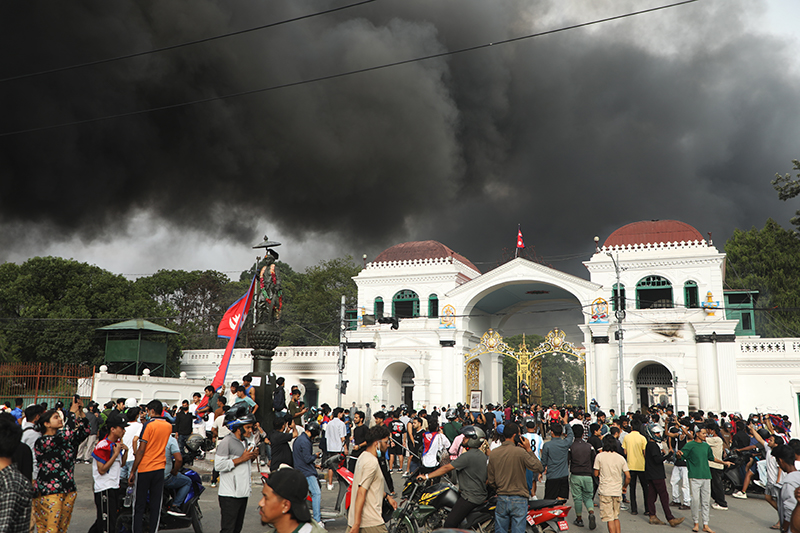
International concern has emerged regarding the substances used to set fire to the Parliament Building, Supreme Court, Singha Durbar and the President's Office during the Gen-Z protests on September 8 and 9 last year. An investigation by the Nepal Investigative Multimedia Journalism Network (NIMJN) has revealed that petroleum products were used to ignite these structures.
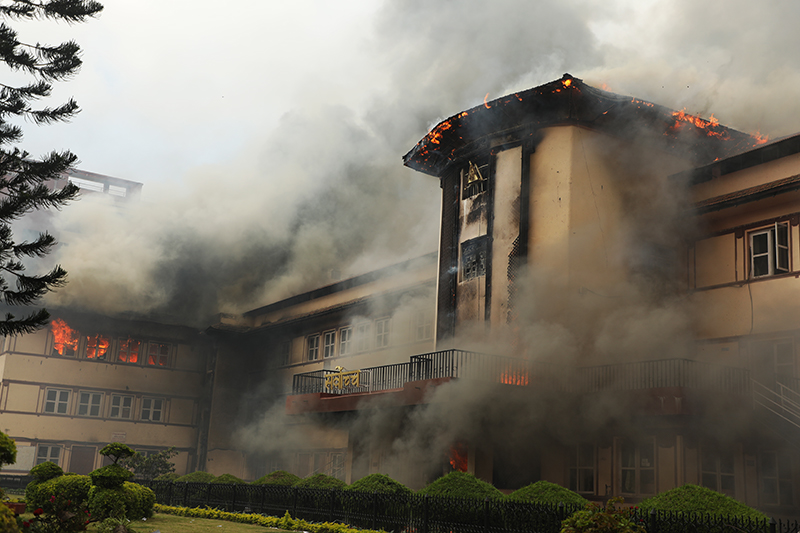
Forensic testing has confirmed that petroleum products were used to burn the Parliament Building, the Supreme Court, Singha Durbar – the country’s main administrative hub – and the President’s Office during the Gen-Z movement on September 8 and 9.
Following the deaths of 19 people, including 17 outside the Parliament Building, during the Gen-Z protests on September 8, violent demonstrations broke out across the country on September 9 in protest.
Petroleum residues were discovered in 16 samples collected from the buildings burned during those protests after being tested at the Central Forensic Science Laboratory under India’s Ministry of Home Affairs. “Residues of petroleum products (petroleum hydrocarbons) were found in the samples,” the report states. One liquid sample sent for testing was explicitly identified as petrol in the forensic report.
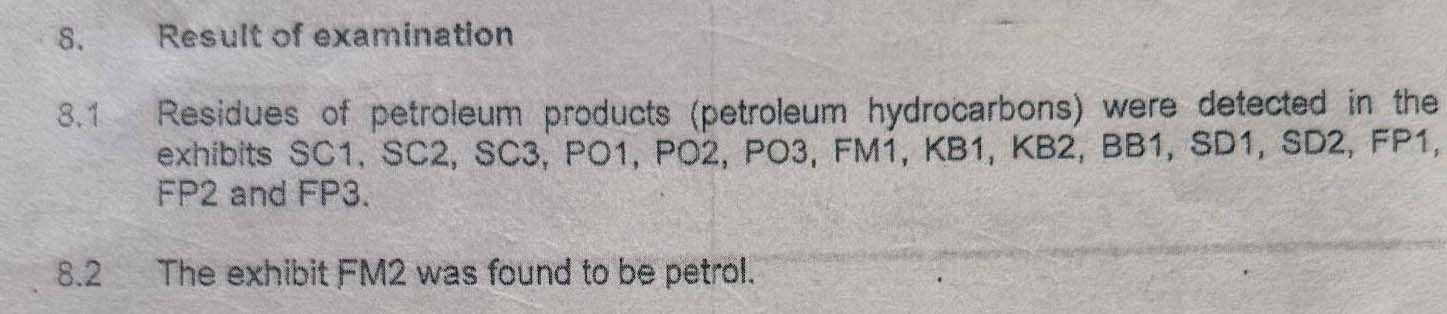
At the laboratory, 16 samples were tested for petroleum products and their residues using physical chemistry methods, chemical testing, thin-layer chromatography and gas chromatography-mass spectrophotometry.
The Nepal Investigative Multimedia Journalism Network (NIMJN) obtained, studied and analyzed this test report, which confirms the use of petroleum substances in the arson. Experts have also stated that if hydrocarbons appear in the results of samples tested from a fire site, it is considered proof that petroleum substances were used.
Dr. Basant Giri, a senior scientist at the Kathmandu Institute of Applied Sciences who holds a PhD in chemistry from the University of Wyoming in the United States, said, “Hydrocarbons are found in samples containing petroleum residues and hydrocarbons are found in petroleum products.”
Fifteen samples, including ash and charcoal collected from the sites of the Gen-Z movement arson, soil from the burned areas, fragments of charred wire, partially burnt wood pieces and damp pieces of half-burnt cloth, were packed in individual zip-lock plastics. Additionally, 12 ml of a yellow liquid substance was placed in a centrifuge tube and sent to the Central Forensic Science Laboratory in Delhi, India.
These materials, placed in sealed cartons wrapped in cloth and secured with tape seals, were collected from the Parliament Building in New Baneshwor, the Supreme Court, burned ministry buildings within the Singha Durbar complex, and the President’s Office.
The forensic report specifies that the liquid substance sent for testing was a petroleum product. It remains unclear how that particular sample, collected from a ministry within Singha Durbar, was obtained.
The commission’s report without the forensic report
Although the Government of Nepal coordinated with the Indian government to conduct these sample tests, the report has not been made public. The commission investigating the events of September 8 and 9 submitted its findings to the government without including the forensic test results.
“We were informed that samples had been sent for testing but the report was not provided to us,” Commission Spokesperson Bigyan Raj Sharma told NIMJN. “We have recommended establishing laboratories in Nepal to test such samples in the future.”
In fact, the report had reached the Ministry of Foreign Affairs through India’s Ministry of Home Affairs on February 9, a month before the commission submitted its findings. NIMJN’s investigation shows that the Ministry of Foreign Affairs forwarded the report to the Ministry of Home Affairs on February 12. The forensic laboratory had begun testing on January 17 and finalized the report by January 30.
Sources indicate that the commission submitted its report based on the assumption that petrol bombs were used at the International Convention Center in Baneshwor (the former Federal Parliament building), buildings within Singha Durbar, Supreme Court and President’s Office.
During the protests on September 8 and 9, a total of 2,671 government, private and community buildings across the country were vandalized or set on fire.
According to the National Planning Commission’s report on the assessment of damages to public property, physical infrastructure and private establishments and the reconstruction plan for public structures, government buildings accounted for the majority of the destruction, with 2,134 structures affected.
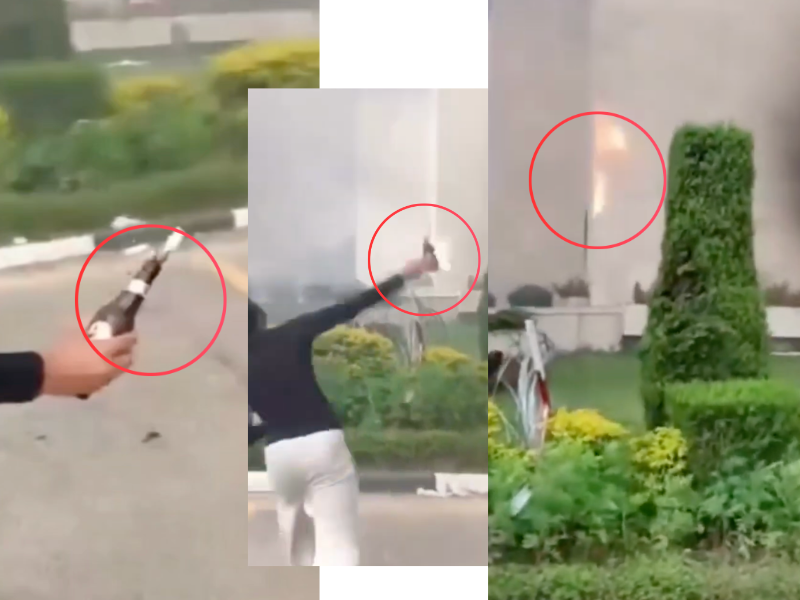
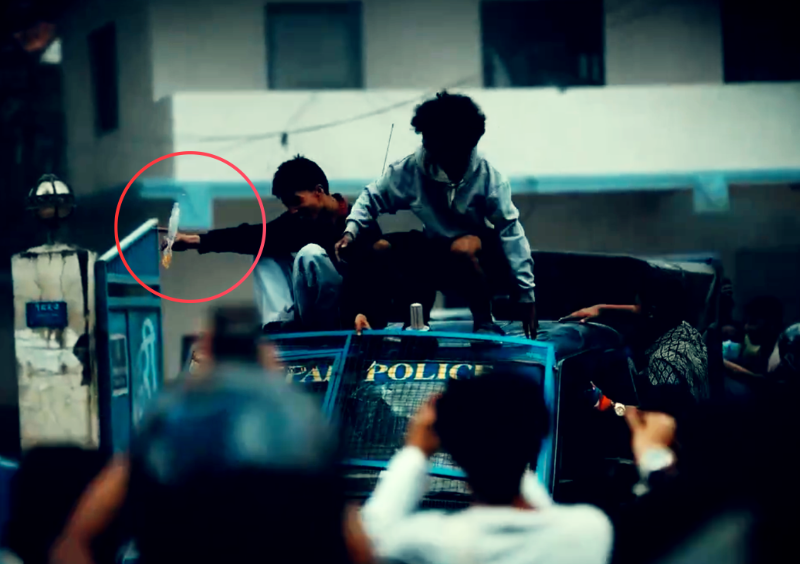
Photographs and videos captured during the movement and posted on social media also show protesters throwing petrol bombs not only at the Parliament Building and the Supreme Court but also in locations outside Kathmandu Valley. NIMJN’s collection and analysis of these images and videos further confirm the use of petrol.
In a TikTok video obtained by NIMJN, several individuals carrying hammers are seen entering the building housing the Prime Minister’s Office in Singha Durbar and vandalizing it before the arson. The video shows them using hammers to smash window panes, tables, and the computers and printers placed on those tables.
How the samples were sent
The Ministry of Home Affairs, having tasked the Nepal Police with collecting the samples, sent them to India for testing in the third week of December. On December 30, India’s Ministry of Home Affairs submitted the samples from Nepal to a government-owned laboratory located on Lodhi Road, New Delhi, for analysis.
A team comprising the Deputy Secretary of India’s Ministry of Home Affairs, a Counselor from the Nepali Embassy in Delhi, and Nepal Police representatives stationed at the embassy coordinated the submission of the samples for testing.
A specialist with an M.Sc. in Organic Chemistry and 31 years of experience in chemical analysis participated in testing the samples and preparing the report (though his name appears in the report, it is not being made public due to confidentiality).
This expert, who provides consultancy to courts in India and abroad, also assists in crime scene investigations to aid police work.
He has consistently provided scientific support for evidence collection and testing. Having submitted reports for over 1,000 cases of national and international significance, he led the testing of chemical substances used to set fire to government and private buildings during Nepal’s Gen-Z movement.
Cover Photo: A protester carrying a petrol bomb in Kathmandu during the Gen-Z movement on September 9. Photo: Barsha Shah/NIMJN
Please adhere to our republishing policy if you'd like to republish this story. You can find the guidelines here.
Comments