
Once a striking destination, Gangapurna Lake in the Nisyang Rural Municipality of Manang is now facing a crisis due to climate change, rising temperatures in the Himalayan region and increasing rainfall in the mountains.
Min Bahadur Gurung from Manang village in Nisyang Rural Municipality still remembers what Gangapurna Lake used to look like. “Blue water, a beautiful lake,” he recalls, remembering how it used to be. “Extremely nice, blue and well-proportioned.” Just a 10-minute walk from Manang village, he has watched the lake slowly get filled in and fade away.
He is worried as the lake, once blue and as beautiful as Tilicho, is now being filled with silt and debris. “Now the water is muddy. The snow melted above and the water turned muddy,” he says. “The water brought down soil and the lake got filled up.”
Right before Min Bahadur’s eyes, the glacier at the head of Gangapurna Lake retreated further and further back. “Earlier, that glacier was right at the top corner of the lake. Now it has moved all the way across,” Min said, pointing toward the mountains above.
It has not been all that long since Gangapurna Lake took on its brilliant blue form. Just as quickly as Gangapurna Lake formed, its existence is now facing a crisis. Once an attractive destination, the lake is currently in crisis due to climate change, rising temperatures in the Himalayas and increasing rainfall in the region. As rising temperatures accelerated the melting of the glacier, the lake expanded in size and looked beautiful. As the glacier retreated further upward, debris began filling the lake. On top of that, heavy rainfall in 2021 broke the lake’s natural dam, causing the water level to drop. Although the local government has made efforts to conserve it since then, those efforts have not been sufficient.
A comparative study of photographs taken by geologist Toni Hagen in 1957 and Zdenek Thoma in 1979 shows that Gangapurna Lake was quite small at that time.
According to a study titled ‘Retreating Glaciers and Advancing Forests Over the Past 200 Years in the Central Himalayas’, after 1979, the glacier melted rapidly at a rate of 24.4 meters per year (a total of 903 meters), and the size of the lake expanded abruptly.
However, debris carried down by the glacier’s outlet stream began accumulating at the mouth of the lake. According to this study report, the elevation of the glacier’s terminus (snout) was 3,529 meters in 1957, which by 2016 had moved further up to an elevation of 3,701 meters. In other words, the ice level has retreated 172 meters upward.
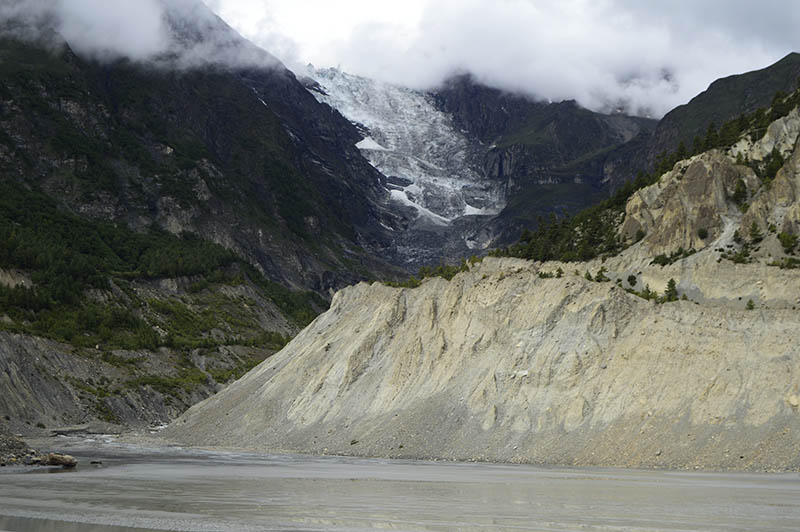
Karma Gurung (65) of Manang village is an eyewitness to this. “Earlier, the glacier reached much further down. Now it is moving higher up. As the glacier melted away, soil washed down from above and the lake gradually filled up,” he said.
Studies have also confirmed what Karma and Min observed about the glacier retreating higher and higher up. According to the research, over the six-decade period from 1957 to 2016, the glacier, considered the primary source of water for Gangapurna Lake, retreated by 1,289 meters (about 1.3 kilometers).
The 2021 flood brought debris
According to Karma, the condition of the lake, already affected as the glacier melted and retreated higher up, worsened significantly after the 2021 flood deposited mud and debris into it. “Rain poured down from the sky. As the hillsides collapsed from all directions, the entire lake was filled in,” he said.
Pema Chhiring Gurung, also from Manang village, similarly notes that the appearance of Gangapurna Lake began changing rapidly following the year of the Manang flood. “Heavy rainfall caused flooding everywhere, in Chame, in Dharapani!” he says. “Yes, that was when this lake got filled up.” He shared that after the downpour, mud, slush and debris poured into the lake from all sides.
Manang, which was battered by floods in September, had also been hit by floods in 2021. Disasters involving floods and landslides, similar to those that struck Tal village and Chame in September, had also occurred in 2021.
According to data from the Department of Hydrology and Meteorology, 848.57 millimeters of rainfall was recorded in the 2021 calendar year at the Humde rainfall measurement station, located slightly below Gangapurna Lake. In the trans-Himalayan ‘rain shadow’ region, this is an excessive amount of rainfall.
Record-breaking rainfall was also recorded in 2024 and 2025. In Humde, where 85 millimeters of rainfall was measured on October 30, 2025, 84.2 millimeters had been recorded on September 28, 2024. Overall, Humde received 549.24 millimeters of rainfall in 2025 and 484.93 millimeters in 2024.
Formed by a glacier, now being silted up by it
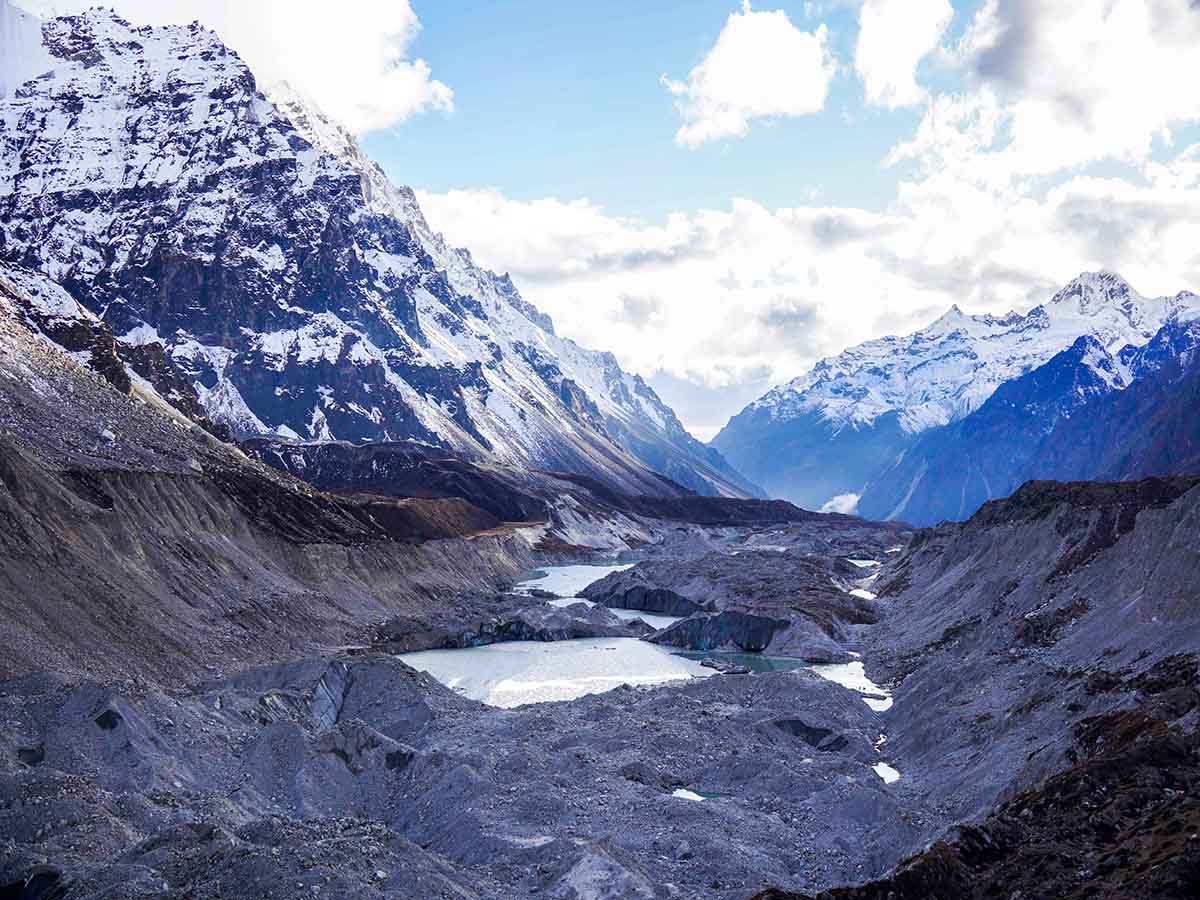
According to scientists, Gangapurna Lake is living proof of a glacial lake formed by climate-change-induced melting that is now being filled in by debris from the very same glacier. A study conducted by a team including researcher Shalikram Sigdel, analyzing tree rings and satellite data, revealed that in just the three decades between 1988 and 2019, the length of the Gangapurna glacier shrank by a total of 10.56%, retreating at a rate of 30.64 meters per year.
The study concludes that as the glacier retreats, landslides occur from the weakened moraine (earth and rock) mounds, and stones and soil continuously wash down from the headwaters, further accelerating the rate at which debris fills the lake.
On one hand, melting glaciers send down floods of debris from the upper reaches, while on the other, the lake is undergoing a natural process of silting up due to the fragile geology. In such a situation, glacier expert Mohan Chand notes that protecting Gangapurna Lake simply by building ordinary walls or embankments is technically very challenging.
The municipality’s failed attempt
To save the lake, the Nisyang Rural Municipality had also built a dam. After the dam was constructed, the lake’s appearance was gradually returning to its former state. However, it was later filled with debris once again. “They built a dam last year but it settled again. Rather than just sand, soil and debris came and filled it up,” Min shared.
Glacier expert Mohan points out that man-made dams are not sufficient for the conservation of Gangapurna, which is facing various changes. “Gangapurna Lake is facing different kinds of changes,” he said. “I feel the dam was built so that the lake would remain a lake and also stay attractive from a tourism perspective but this wasn’t enough.” Gangapurna Lake is a destination that extends tourists’ stays in Manang by a day. However, local residents say that tourist arrivals have decreased after the 2021 flood completely destroyed the lake’s natural dam and filled the lake up.
Glacier expert Mohan explains that once the natural dam burst, all the water drained out and debris accumulated, bringing the lake to the verge of disappearing. “Just as the mounds of ice keep moving higher and higher,” he says, “Similarly, if the ice keeps melting that way, there is a possibility that the glacier above will disappear one day in the long run.” He noted that once the glacier is gone, no matter how large a dam is built there, the risk remains that there will be no water in the lake.
Contractors abandoned the work midway
After the 2021 flood impacted the lake, the rural municipality signed a contract with Jaljala Shivashakti/Adhikari JV on October 10, 2021, for the conservation of Gangapurna Lake. According to the agreement, the work was supposed to be completed by December 2022/January 2023. However, the project remains unfinished to this day.
According to Chhiring Gurung, Vice-Chairperson of Nisyang Rural Municipality, the project has been stalled for a long time after the contractor walked away without completing the work. “The construction company didn’t finish the job. They abandoned the work without any reason. Since then, the project has been on hold,” he said. “It has also been discussed in the executive committee to have the same contractor resume the work starting this year.”
He explains that they are looking for other alternatives because terminating the contract involves legal complications.
“At that time, they took a fairly large advance payment. We didn’t cancel the contract because reclaiming the advance after termination takes time and becomes difficult,” Vice-Chairperson Chhiring said, explaining the legal hurdles. “Therefore, it has been decided to push the same contractor to complete the work quickly.”
Although the Vice-Chairperson spoke of getting the same contractor back on the job, Rural Municipality Chairperson Kanchha Gurung says the awarded contractor is out of contact. “It went through a tender process and the contractor simply didn’t show up,” he said. “We have been calling them but nothing has happened so far.”
According to the rural municipality, the contractor took an advance of Rs 5,234,000. Vice-Chairperson Chhiring notes that the contractor initially did a little bit of work but halted operations after an excavator (JCB) brought into the lake to remove debris got stuck there.
Pankaj Adhikari of Jaljala Shivashakti/Adhikari JV, which was awarded the construction contract, also admits that work was disrupted after the JCB got stuck in the lake. He states that the work came to a standstill due to flaws in the project design and geographical complexities. “Soil was excavated from one side of the lake and the machine got stuck. After the machine got bogged down, I said, ‘We cannot remove soil like this’,” Pankaj recounted.
He alleges that after encountering problems midway through the work, he proposed changing the project’s design but the municipality ignored his request. “Let’s change the design. Excavating the soil isn’t feasible. We need to bring in technicians to revise the design and I am ready to work,” he said. He adds that although clearing the trees below the lake to build a dam there was a viable alternative, the municipality did not listen to his proposal.
Indeed, the Office of the Auditor General (OAG) has also raised questions regarding the contracting process and the physical progress of the project. The OAG’s audit report for the Fiscal Year 2022/23 notes that physical progress stood at just 7%. The Auditor General questioned the municipality for showing no record of pressing the contractor to submit explanations for the delay, making a decision on a deadline extension, or extending the validity of the advance payment and bank guarantees.
At that time, the Auditor General had recommended either getting the contractor to complete the work or taking action in accordance with the law. Under Section 121 of the Public Procurement Act, 2007, if work under a procurement contract is not completed within the stipulated timeframe due to delays on the part of the contractor, liquidated damages of 0.05% of the contract amount per day of delay must be imposed.
However, as the work remained unfinished within the contract deadline without any extension, and with progress stuck at only 7% despite an eight-month delay by the time of the audit, provisions allow for recovering damages at 0.05% of the contract amount per day, capped at a maximum of 10%. The OAG’s 2022/23 report states that Rs 2,957,448 should be recovered from the contractor.
Earlier, in its audit report for the Fiscal Year 2021/22, the Auditor General had also flagged the issue of an insufficient performance bond being collected. While the municipality had prepared a cost estimate of Rs 40,711,385.66 for the Gangapurna Lake conservation project and invited bids, Jaljala Shivashakti/Adhikari JV was awarded the contract to complete the work for Rs 29,574,485.57. Questioning the agreement, the OAG wrote in its report: “Whereas a performance bond of Rs 3,993,820 should have been collected as per the agreement, only Rs 3,267,600 was taken, therefore, an additional bond for the shortfall amount of Rs 726,220.38 must be obtained.”
Cover photo: Gangapurna Lake. Photo: Reena Thapa/NIMJN
Please adhere to our republishing policy if you'd like to republish this story. You can find the guidelines here.



Comments