
During the monsoon, the government sends tens of millions of SMS messages as flood early warnings. However, these alerts have proven ineffective because they do not arrive on time, are often incomprehensible when they do arrive because they are not in local languages, and fail to provide instructions on what actions to take after receiving them.
On the evening of July 29, following torrential rainfall, the Kapan area of Kathmandu was inundated. A branch of the Rudramati (also known as the Dhobikhola) swept into Nayabasti in Budhanilkantha Municipality-13. Near the confluence of the Rudramati and the streams originating from Chunikhel and Narayanthan, the floodwaters swept away clothes, fabrics and even a bed from Mukesh Gupta’s shop.
Gupta shared that the sudden rush of water into his shop also broke the clothing racks. “Since I was alone, I couldn’t salvage all the goods at once,” said Gupta, who has been running his business there for three years. “I suffered losses worth around 100,000 rupees. How am I supposed to recover from such a loss during this economic slowdown!”
That same evening, half a kilometer away from Gupta’s shop, the floodwaters broke into the ground floor of Nabaraj Karki’s house in Rudramati Chowk, Budhanilkantha-10. The belongings of the students renting rooms there were submerged. “We never know when a flood will strike this Dhobikhola (Rudramati),” Karki said. “If a flood like this had hit in the middle of the night, what would we have done?”
Mahendra Raj Regmi, the coordinator at Brain Land Academy located right next to Karki’s home, shared that around 7 p.m. that evening, the flood submerged the school premises, from the compound to the ground-floor classrooms and toilets. He said the school had to be closed the next day for cleanup.
According to coordinator Mahendra Raj, the lack of early warning about the flood led to the destruction of educational materials at the school. “If flood forecasts and early warnings aren’t effectively delivered even in a capital city like Kathmandu, what must be the condition in other districts?” he questioned.
Like Mahendra Raj, shopkeeper Mukesh and local resident Nabaraj share the same grievance: they received no advance information about the potential flood. Had they received prior warning, they could have saved their goods and belongings from damage.
The Department of Hydrology and Meteorology, however, presents a different account. On July 29, SMS alerts were sent to mobile phones warning that flooding could occur in the Rudramati, Manohara, Bishnumati and Hanumante areas under the Bagmati basin. “Because a flood was predicted that day, an SMS was dispatched at 7:45 p.m.,” said Binod Parajuli, chief of the department’s Flood Early Warning Section.
The SMS message dispatched at the time read: “Water levels are rising in the Bagmati, Bishnumati, Dhobikhola, Hanumante, Manohara and other rivers, with more rain forecasted tonight. Residents in flood-prone areas along the rivers and commuters traveling along the corridors are advised to remain alert until morning.”
According to department data, 2,601,966 SMS messages were dispatched via Nepal Telecom and Ncell that evening to alert mobile numbers across the Bagmati basin area. However, Nabaraj, shopkeeper Mukesh, and teacher Mahendra Raj, who all live right along the banks of the Rudramati (also known as Dhobikhola), stated that no such message arrived on their mobile phones. Teacher Mahendra Raj shared that while early warning messages used to arrive occasionally in past years, he had received no flood-related alerts at all this year.
However, Binod, an expert at the Department of Hydrology and Meteorology, claims that while there are issues with delayed delivery in some cases, it is not possible for messages not to be sent at all. According to him, once a flood risk is identified, early warning messages are dispatched to mobile numbers that were active along the riverbanks within the last 24 hours. For example, if a person who was in Kathmandu, a potential flood-affected area, in the morning reaches Janakpur by the evening, they will still receive the message on their phone. Conversely, if someone who was in Janakpur in the morning arrives in Kathmandu’s flood-risk zone by the evening, the message will not reach them.
All three flood-affected individuals along the Rudramati corridor complained that despite having stayed in the Kapan area over the preceding week, no such message arrived. “Receiving a message is a good thing but ordinary people don’t check text messages all the time anyway. Either a phone call should be made,” says teacher Mahendra Raj, “Or the local municipality needs to provide this information.”
Also read: The River Came at Nine
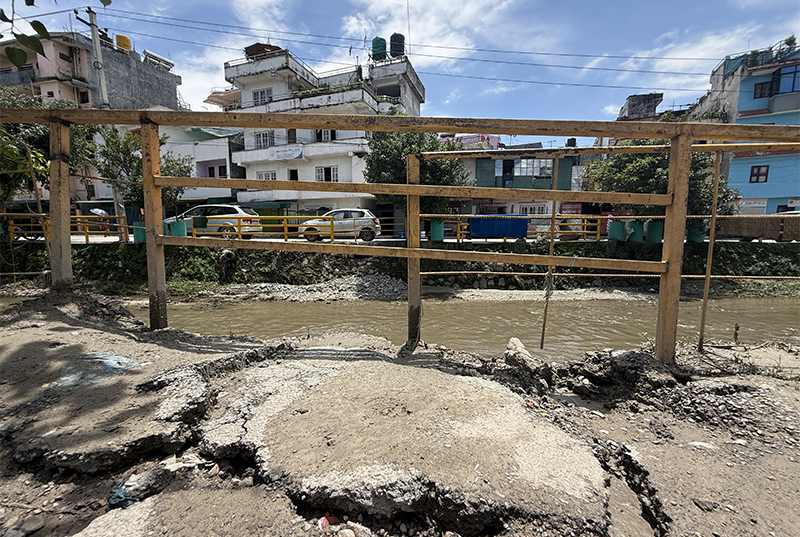
This is not the first time that residents in target areas within the federal capital have failed to receive flood early warnings. Two years ago, on September 28, 2024, flooding from Lalitpur’s Nakkhu Stream inundated the ground floor of Mediciti Hospital located along its bank. Equipment in the emergency and OPD wards was damaged, and patients on that floor had to be moved elsewhere.
The ground floor of Sunrise Apartment, situated near the hospital, was also submerged. Moreover, the Nakkhu Stream flood directly affected over 300 homes at the time. Yet, residents of the affected area complained that no prior warning whatsoever was issued about the flood.
However, Binod, chief of the Department of Hydrology and Meteorology’s Flood Early Warning Section, states that even back then, advance warnings had been dispatched the day before, cautioning that flooding and inundation could occur. According to him, an SMS was sent to approximately 100,000 mobile numbers via Ncell and Nepal Telecom.
When studying early warning delivery among affected residents following the flood, Nakkhu locals complained that the SMS arrived late. They told the department, “Your warning message did arrive but only after the flooding and inundation had already happened.”
Why do flood warning SMS alerts fail or arrive late?
“When messages are dispatched to a large crowd all at once, network congestion and jams occur,” said Binod. “Although SMS is more accessible than other early warning systems, it still faces certain challenges. However, its benefits are substantial.”
To provide advance flood warnings, the Government of Nepal utilizes various channels, including SMS, warning sirens, social media updates, a dedicated hotline (1155) and official bulletins. According to the National Disaster Risk Reduction and Management Authority, emergency sirens have been installed in 49 locations across the country. However, no government-installed sirens are currently operational in the Kathmandu Valley.
Despite existing challenges in other early warning channels, the government continues to treat the SMS system as an effective tool. Nevertheless, there appears to be little to no government-led research on whether this system is truly delivering on its intended impact.
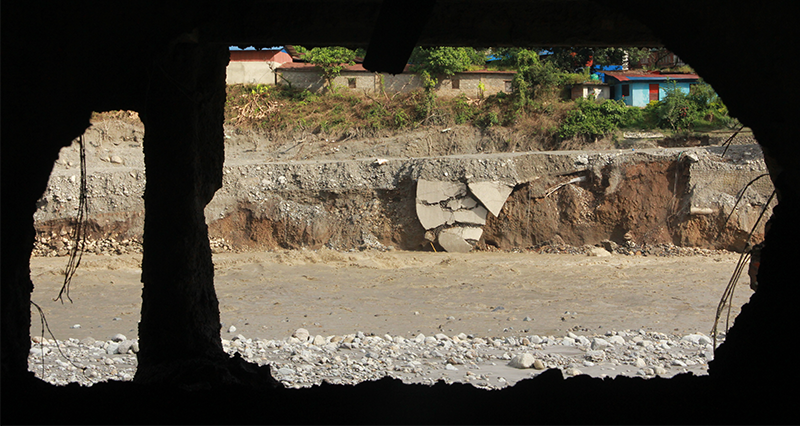
NIMJN selected 15 mobile numbers among those sent SMS alerts during the July 29 flood on the Rudramati to test their effectiveness. When contacted using the numbers provided by the department itself, only one person stated that they had received the early warning message.
Om Prakash Sah, residing at Setopul, was among those who reported receiving no message. No early warning SMS regarding the July 29 flood was found on Sah’s phone, even though other SMS messages from the preceding and following weeks remained intact.
Following a phone conversation, we met him at his workplace in Handigaun and examined the SMS inbox on his phone with his permission. Seeing no such alert listed, Om Prakash remarked, “I told you over the phone that no such SMS had arrived but you didn’t believe me. Now you see!”
Early warning expert Anup Khanal explains that relying solely on the SMS system as a means of early warning risks failing to reach people in vulnerable areas. According to him, the SMS medium remains challenging in regions of Nepal with difficult terrain and limited access to reliable internet or mobile networks. “That is why, in many instances, the SMS arrives only after the flood has hit, or sometimes fails to arrive altogether,” he said.
Furthermore, expert Khanal noted that because the early warning system remains centralized within the Department of Hydrology and Meteorology, responding immediately to varying local conditions across the country remains difficult. He stresses that whether through SMS or other channels, access to early warning systems must be expanded down to the local level.
“Not just in Kathmandu but across all of Nepal, running everything off the department’s central server creates severe network loads that cause delays,” Khanal said. “That is why information access must first reach the municipal level. From there, warnings can be issued via SMS or sirens in local languages as needed.”
Not everyone understands the message
The Department of Hydrology and Meteorology has been sending SMS messages for early warnings for years. According to department data, over 100 million flood early warning SMS messages were dispatched across the country over the past five years, from 2021 to 2025 (2078 to 2082 BS). During this period, department records show that 58,439,788 messages were sent via Nepal Telecom and 48,227,402 via Ncell.
When dispatching between 100,000 and 1,000,000 SMS messages, Nepal Telecom charges 40 paisa per SMS, while Ncell charges at a rate of 1 rupee. Based on these rates alone, over the past five years, flood early warning SMS messages worth 19,290,960 rupees were dispatched via Nepal Telecom, and 58,439,788 rupees via Ncell. Across both service providers, SMS messages totaling 77,730,748 rupees were dispatched.
Department data shows that even within the Kathmandu Valley alone, over 10 million SMS messages were sent over the past five years.
However, various studies have shown that the SMS medium in the early warning system has failed to adequately inform residents in vulnerable areas. A 2020 study conducted by Practical Action in collaboration with the UK’s University of Cambridge and Nepali experts, titled “How is Complex Forecast Information Communicated? An Analysis of Nepal’s Flood Early Warning System”, revealed that the SMS system used for flood early warnings in Nepal is not accessible to everyone.
In the study, which covered Jhapa in the east, Nawalparasi in central Nepal, and Bardiya and Kailali in the west, only 33% of respondents reported receiving the early warning SMS. Even among that 33% who received the message, 40% stated that the SMS was ‘very difficult’ to understand.
Of those who received the alert, 57% rated their understanding of the warning at 5 or lower out of 10. Meanwhile, 52% felt that the information should be provided in a different format and 61% preferred direct, personalized communications, with 17% explicitly requesting voice messages.
Additionally, 46% stated that they were unable to take action based on the SMS. Among them, 27% cited illiteracy, while 16% cited difficulties in decision-making.
The study also highlighted that Dalits and socially or economically marginalized individuals were entirely deprived of SMS-based early warnings. Older adults were found to be particularly vulnerable, struggling both to understand the SMS messages and to take action based on them.
Also read: Mud Everywhere, Bodies Left Uncollected, and Rescue Without a Rope
According to Binod, chief of the Department of Hydrology and Meteorology’s Flood Early Warning Section, some improvements have been made during this period. He stated that lengthy messages have been trimmed down to easily understandable single-sentence alerts. “Similarly, whereas messages were previously sent to everyone across an entire district, they are now targeted specifically at high-risk areas,” he said. “English and Romanized script have been replaced with alerts sent directly in Nepali. There are still areas that require improvement and we have not yet been able to educate people on what actions to take upon receiving a message.”
A 2025 study titled “Challenges and Opportunities in Nepal’s Early Warning System” by researcher Dinanath Bhandari, published in the International Journal of Disaster Risk Reduction, revealed significant weaknesses and ambiguities within the existing institutional mechanisms for flood and landslide early warning systems. The study particularly highlighted the lack of a clear division of roles among federal, provincial and local government bodies.
The study noted that although the Department of Hydrology and Meteorology, Nepal Telecom, and Ncell operate the toll-free hotline 1155 during the monsoon season to provide weather and flood updates, only a few individuals consulted at the district level were aware of the number. None of the people surveyed in the study areas had ever called 1155 to check weather or flood conditions.
Participants in the study also expressed concern over receiving SMS alerts late and finding the messages unclear. The research showed that an SMS dispatched via mobile networks took up to 1 hour and 43 minutes to reach recipients. Some participants reported receiving alerts as late as six hours after they were sent.
Over 90% of study participants reported getting information from online news portals, social media, particularly Facebook, and family members. A majority of illiterate respondents preferred voice messages. The study also revealed that individuals with visual, hearing or psychosocial disabilities rely on family members’ assistance to receive information.
Gaurav Sagar Devkota, while conducting PhD research at King’s College London in 2023, authored a study titled “Cross-Border Early Warning System in the Koshi River Basin and Its Understanding of Cultural Context”. His findings present a different perspective. The Department of Hydrology and Meteorology reported that 200,000 people in the Koshi River Basin received early warning SMS alerts in 2018. However, with the population in the Koshi River Basin standing at approximately six million, the information reached only about 3% of the population.
According to the study, bilateral committees have been formed to foster collaborative work on flood risk management at the transboundary level. However, these committees remain centrally driven, overly focused on water resource management, and detached from the participation of vulnerable communities and local government institutions. Consequently, disaster risk management processes and the transboundary early warning system in the Koshi River Basin have been further complicated by geopolitics surrounding shared water resources.
The study argues that there is a tendency to give only limited consideration to local contexts across the various stages of the early warning system. It notes that socio-cultural norms and gender barriers obstruct access to early warnings, particularly for women and marginalized communities.
According to the study, whether vulnerable populations even comprehend the early warning SMS remains another major question. The department reports that while alerts were previously dispatched in English, they are now sent in Romanized Nepali and Devanagari scripts. However, for many people residing in areas vulnerable to flooding along the Koshi River, Maithili is their primary language. During the study, 82% of respondents suggested that receiving early warnings in the Maithili language would be far more effective.
Among community-level respondents who received the early warning SMS, 67% complained that the alert was not useful. They stated that receiving information merely one to two hours before a flood strikes does not leave sufficient time to make necessary preparations to protect themselves.
A study titled “Cost-Benefit Analysis of Flood Early Warning System in Nepal” also emphasized the need to deliver early warnings faster and more effectively. Based on a survey of 453 households in the Lower Karnali River Basin, alongside 30 focus group discussions and interviews with 40 key informants, the findings revealed that extending the advance notice time by just one additional hour could increase current savings by 1.83 times.
The flood event in Thame, Solukhumbu, on August 16, 2024, serves as a clear example of why extending advance warning lead times is critical. According to the Department of Hydrology and Meteorology’s own publication, “Climate Change Status of Nepal 2024”, the flood in Thame Khola struck at approximately 1:30 p.m.
Department data shows that by 2:30 p.m., the department had dispatched early warning SMS messages to approximately 142,000 residents in downstream settlements stretching from Thame in Solukhumbu to Okhaldhunga. As a result, residents in the lower riparian areas were able to take precautionary measures.
However, that instance involved a flash flood caused by a glacial lake outburst. Such luxury of time is not always available during floods. Experts emphasize that along with expanding public access to early warnings, it is essential for the department to enhance its capacity for forecasting disasters.
“The early warning system has improved compared to earlier times but it remains inadequate. As long as forecasting capacity is not upgraded, merely having an early warning delivery system is not enough,” says early warning system expert Dinanath Bhandari. “Unless both are improved, people will continue to lose their lives due to the failure to receive timely warnings.”
Why are SMS alerts delayed?
Sending SMS alerts for early warnings is not enough on its own. They must also arrive on time. Regarding the delays and reach of these SMS messages, Binod, chief of the department’s Flood Early Warning Section, points to technical limitations. According to him, the department has the capacity to send SMS alerts six to eight hours before a flood strikes in major rivers. However, as the river size decreases, the forecasting window shrinks significantly. For smaller rivers, the department is only able to forecast and dispatch SMS alerts three hours, one hour or even just 20 minutes in advance.
Currently, the department possesses the capacity to monitor and run SMS warning services based on flood forecasts for 273 rivers and streams across the country. For all of these locations, the department must handle the operations entirely on its own.
“First, forecasting must be made more reliable. After that, a national-level integrated early warning system needs to be established. Early warnings regarding disasters must reach every local unit. In doing so, technology should be fully leveraged by utilizing robotics, satellite technology, drone-based systems and cell broadcasting.”
If multiple rivers cross warning or danger levels simultaneously, the department’s system does not automatically dispatch early warnings. In such situations, the SMS process must be initiated manually by staff. “Because our human resources handle this manually, delays occasionally occur,” Binod explains.
According to him, the department dispatches approximately 200 SMS messages per second. However, when broadcasting alerts to hundreds of thousands of people at once in an urban setting like Kathmandu, the process takes over 30 minutes. Binod adds, “When sudden flash floods originate upstream, we have received complaints that the SMS alert and the flood waters arrived at the exact same time.”
To overcome these challenges, he noted that the Government of Nepal plans to develop Cell Broadcasting and Interactive Voice Response (IVR) systems for disaster early warnings. Under this proposed framework, alerts would trigger vibrations or automated phone calls on mobile devices even without an active SIM card or internet connection.
According to Kamal Lamichhane, spokesperson for Nepal Telecom, there are three main reasons why broadcasting hundreds of thousands of SMS alerts at once sometimes fails to reach everyone immediately: first, network towers in the targeted area temporarily malfunctioning; second, recipient mobile phones being turned off; and third, heavy network congestion within the SMS delivery system.
When asked what percentage of disaster-related SMS alerts fail to deliver or bounce back, Lamichhane stated, “Determining exact delivery success rates requires extensive study and time. However, the majority of SMS messages do go through. Delays occur primarily when technical glitches arise.”
Ncell has been dispatching disaster early warning SMS messages as part of its corporate social responsibility initiatives since 2016. A representative from Ncell’s communications division noted that while messages are dispatched within minutes of receiving instructions from the Department of Hydrology and Meteorology, assessing how many actually reach recipients remains difficult. “Dispatched SMS alerts are delivered within minutes. However, some may fail to go through due to recipient phones being powered off or traffic congestion from transmitting large volumes of messages simultaneously.”
Both Nepal Telecom and Ncell provide these flood early warning SMS services free of charge based on data and information provided by the Department of Hydrology and Meteorology.
What should be done now?
The United Nations has set forth an initiative to ensure community-level early warning access by 2027 and universal access for every individual by 2030. Nepal is a signatory state to this framework.
Nepal regularly suffers from disasters such as floods, inundation, glacial lake outburst floods, avalanches, landslides, lightning, heatwaves and cold waves. However, the Department of Hydrology and Meteorology has yet to establish mechanisms capable of forecasting and providing early warnings for all of these hazards. Currently, weather forecasting remains primarily focused on rainfall forecasting and, by extension, flood forecasting. Even within that scope, significant limitations persist.
According to experts, hazard forecasting and accurate alerts are achievable only when risk assessments are conducted properly. Yet, disaster risk assessments in Nepal remain fundamentally inadequate. For example, comprehensive mapping identifying which communities and households are most vulnerable to landslides has not been undertaken.
Department expert Binod Parajuli notes that while some progress has been made regarding flood warnings, substantial work remains for other disasters. “Without new technological developments, dedicated research, sufficient budget and adequate human resources, meeting the 2027 target for universal early warning coverage appears unlikely. Nevertheless, far greater effort is being made now compared to the past,” he said.
Early warning system expert Anup Khanal similarly points out that Nepal’s geographical terrain will make ensuring universal early warning access by 2030 difficult. He emphasizes that achieving this goal requires expanding network connectivity and communication infrastructure across the entire country. “Along with early warning systems, physical infrastructure must be developed,” he said. “Rather than relying solely on mobile networks, we must expand siren networks and alternative wireless technologies.”
Dharma Raj Upreti, head of the National Disaster Risk Reduction and Management Authority, notes that given the state’s institutional limitations, the ability to dispatch alerts through partnerships with Ncell and Nepal Telecom remains a positive achievement. However, acknowledging limitations in delivery processes and reach, he shared that plans are underway to implement a Cell Broadcasting System as an immediate technical upgrade.
“To address the challenge of delayed messages, we are developing a Cell Broadcasting System. With this system, the mobile phone vibrates automatically and sounds a siren. This eliminates the issue of people missing messages while sleeping at night. It even functions without a SIM card,” he said. “However, installing this system is estimated to require an initial investment of 250 million rupees.”
Meanwhile, early warning system expert Dinanath asserts that expanding early warning coverage solely from the central level is insufficient. He argues that explicit responsibilities and accountability regarding the early warning system must be designated across all relevant government bodies at the federal, provincial and local levels.
“First, forecasting must be made more reliable. Following that, a national-level integrated early warning system needs to be established. Disaster early warnings must reach every local unit. In doing so, technology should be fully leveraged by utilising robotics, satellite technology, drone-based systems and mobile broadcasting,” Dinanath said.
He observes that access to early warnings remains limited partly because activity in these efforts is concentrated almost entirely at the central level within the Department of Hydrology and Meteorology and the Disaster Authority.
Dinanath’s analysis also highlights that the Disaster Risk Reduction and Management Act, 2017 has not been implemented effectively. According to him, while the legislation stipulates developing and operating national early warning systems, disseminating advance notices of potential disaster events, operating provincial disaster management information systems, and setting up disaster management information systems at the local level, it fails to specify who bears responsibility or accountability if these tasks remain unfulfilled.
“Local levels, provinces and private organizations can choose to develop early warning systems if they deem it necessary,” Dinanath explains. “However, if they do not deem it necessary and take no action, there is no framework holding them accountable to anyone. That is precisely why the necessary amount of work has not taken place.”
Cover Photo: Local residents watching the floodwaters of the Rudramati River. Photo: Anita Bhetwal/NIMJN
In collaboration with Report for the World. Please adhere to our republishing policy if you'd like to republish this story. You can find the guidelines here.
Comments