
Schools completely damaged by floods in Rasuwa, Nuwakot and Dhading want to ease the trauma of the flood by gathering students in one place to offer psychosocial counseling and resume classes. However, they are struggling to manage the necessary infrastructure to operate the schools.
The flood that occurred on August 26 left no trace of the 11 buildings at Tribhuvan Trishuli Secondary School in Nuwakot. Although the riverbank school compound has now been turned into a barren gravel bed, Headmaster Rajendra Dawadi is planning to resume school operations.
In Rasuwa, Suroj Dangol, proprietor and principal of Modern Trinity English Boarding School near Betrawati in Uttargaya Rural Municipality, which runs classes up to grade seven, along with teacher Sushma Tamang and 10 students, went missing in the flood.
Requesting parents to keep children at home in safe places, Suroj had sent a voice message to the parents’ WhatsApp group at 9:12 a.m. on August 26, stating that he would keep the students who had already arrived at school safe. Although the students who had reached the school were saved, Suroj himself went missing in the flood.
Also read: The River Came at Nine
Suroj’s final funeral rites have already been completed. Overcoming the grief of losing her husband Suroj alongside 57 relatives within the 13-day mourning lineage missing in the flood, administrator Sirjana Bhandari Dangol wants to reopen the school. She says, “A river now flows where the school once stood. There is a lack of space to run the school.”
Confident that the school can be revived if she gets support from the government, the private school umbrella organization PABSON and the community, she has come to Kathmandu seeking assistance and support.
According to the Ministry of Education and Sports, the flood on August 26 damaged not only Modern Trinity and Tribhuvan Secondary School in Betrawati, but also left 11 schools completely destroyed across Rasuwa, Nuwakot and Dhading. Among them are eight community schools, two institutional schools and one religious school.
Suraj Pyakurel, a parent at Modern Trinity, shared his confusion about where to send his children for their studies after the flood swept away their school. “All four of my children studied at that same school. Now, there is no trace of the school left,” he said. “We have to send them to school now but I have no idea where to enroll them.” Residing in Bogatitar, his children study in Playgroup, UKG, Grade 4 and Grade 6.
Although school administrators, teachers and parents affected by the flood want to resume classes, the lack of space remains a major hurdle. Rajendra Dawadi, Headmaster of Tribhuvan Trishuli Secondary School, stated that students and parents are constantly asking when classes will resume but delays persist due to difficulties in managing alternative space.
Headmaster Rajendra mentioned that whether students lost relatives or were left mentally traumatized after losing their homes, they want to gather them in one place to offer comfort. “We want to lighten their burden by letting them share their pain with one another,” he says. “We wish to keep our students together and provide them with psychosocial counseling through experts and doctors.”
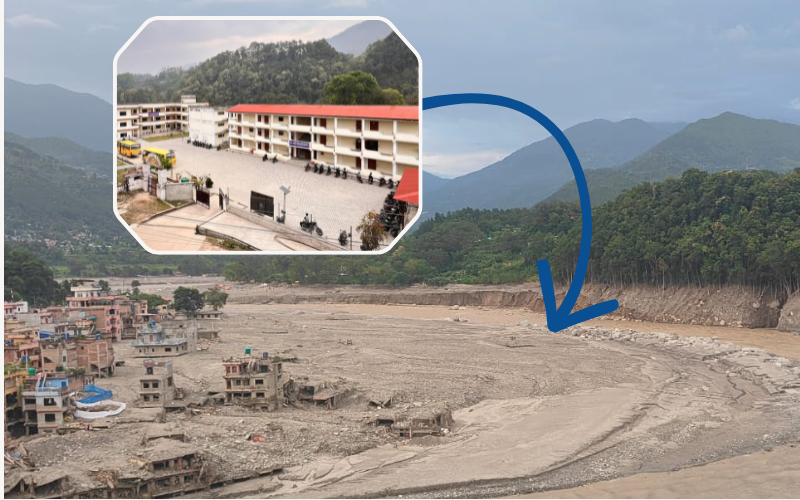
One student is missing from this school, which has an enrollment of 1,643 students. Although most students had already arrived at school when the flood struck, the school safely relocated them to secure ground after receiving early warning.
“It is only the school’s infrastructure that was swept away. Our students and teachers are safe,” he says. “Moments before the flood arrived, we were all together in one place but now we are scattered. By restarting the school, we are trying to bring everyone together again.”
Assurance of buildings for those without space
On September 8, Education and Sports Minister Sasmit Pokharel visited Bidur to monitor the impact of the flood on the education sector. During a discussion involving local representatives and members of the Tribhuvan Trishuli Secondary School Management Committee, he assured that the federal government would construct a new building once space was managed.
However, rather than future buildings, the school is currently facing an immediate shortage of space to run regular classes. Bidur Municipality has granted permission to set up temporary learning centers using buildings and land located in Dihi Bazaar under the jurisdiction of the federal and provincial governments. It has also sent a letter to the Department of Urban Development and Building Construction requesting the infrastructure to be made available. Yet, the plan to resume regular classes has not materialized.
School operations became uncertain after a provincial office under the Bagmati Province Ministry of Physical Infrastructure Development located there refused to allow the use of its building.
“Our effort to use that structure to gather students in one place and immediately start psychosocial counseling was stalled due to obstruction from the provincial office staff,” said Prabha Bogati, Deputy Mayor of Bidur Municipality. “We have also discussed this with the Chief Minister. It will likely be resolved soon.”
Although the municipality accuses the province of hindering school operations, Bagmati Province Minister for Physical Infrastructure Development Bharat KC is unwilling to accept this. He stated that the province would support the site permitted by the municipality to temporarily operate classes. “We will provide support,” he said.
He added that the province has already decided to construct residential facilities targeting students from flood-affected schools. “Right now, we will make space available wherever provincial infrastructure and land are located to run regular classes,” said Bagmati Province Infrastructure Minister Bharat. “In the long term, we will also invest in infrastructure to accommodate and teach displaced students together in one place.”
Rajendra, Headmaster of Tribhuvan Trishuli Secondary School, says donors are also ready to assist in operating the completely destroyed schools. There are donors willing to provide necessary educational materials and uniforms to the students as well. However, he noted that teachers and students have not even been able to meet due to the lack of space.
“Donors are ready to provide educational structures to start school immediately. The federal government has also said it will build the buildings. However, land has not been obtained.’
Floods affect studies of 9,500 students
In addition to the 11 flood-damaged schools in Rasuwa, Nuwakot and Dhading, classes have also been suspended in 14 other schools. According to the ministry, a total of 9,430 students, including 2,250 in Rasuwa, 3,717 in Nuwakot and 3,463 in Dhading, have been deprived of their education.
Damaged school buildings are not the only reason classes have stopped. According to the ministry, 14 schools across the three districts are being used as shelters for more than 2,200 people. As a result, classes have been halted in those schools as well.
“Although some schools were not directly hit by the floods, they have been severely affected because they are being used as holding shelters,” said Jiban Bhandari, an Under Secretary deployed by the ministry to Nuwakot to monitor the damage caused by the flood. “Alternative arrangements are necessary for them as well.”
One of the schools where studies have been affected due to holding shelters and relief operations is Nilkantha Secondary School in Uttargaya Rural Municipality, Rasuwa. Relief materials are stacked in the classrooms of this school. The building has been turned into a barracks for the Army and the Armed Police Force, while the rural municipality operates its administrative work from the school office.
Relief materials are stocked on the student playground and vehicles from donor organizations are parked there. “Relief supplies for the entire rural municipality are stored in the school and the municipality’s office is also operating from here,” said Headmaster Madhav Lamichhane. “We have started counseling students gathered in whatever empty space is available.”
Since it sits well above the riverbank, the school’s physical infrastructure suffered no damage. However, the school remains in mourning over lost students and teachers. He stated that 102 students, three teachers and one staff member went missing in the flood. More than 500 students are enrolled here.
Students attending this school come from Bidur and Battar in Nuwakot, as well as from across the Trishuli River in Uttargaya itself. Because the flood swept away bridges and roads, direct contact between Nilkantha Secondary School and Bidur, Battar and the other side of the Trishuli River has been cut off. To check on the status of students in that area, the school has assigned teachers residing in those locations.
Relocation required for completely destroyed schools
A study team deployed by the Ministry of Education has concluded that there is no possibility of re-operating the schools on the same sites where they were completely destroyed by floods. Under Secretary Jiban Bhandari, who returned from monitoring Nuwakot, stated that buildings, classrooms, toilets, drinking water facilities, compounds and access infrastructure in the affected schools have been completely damaged, making immediate relocation necessary. “A river is now flowing where the school used to be, so there is no possibility of building structures on the same spot again,” he said. “Relocating the schools to another location is essential.”
The floods have not only swept away school buildings but have also damaged other essential physical infrastructure, including roads, bridges and communications. With bridges washed away, connection has been completely severed between several settlements and schools. Additionally, some school operators, teachers, students and their relatives remain missing in the flood.
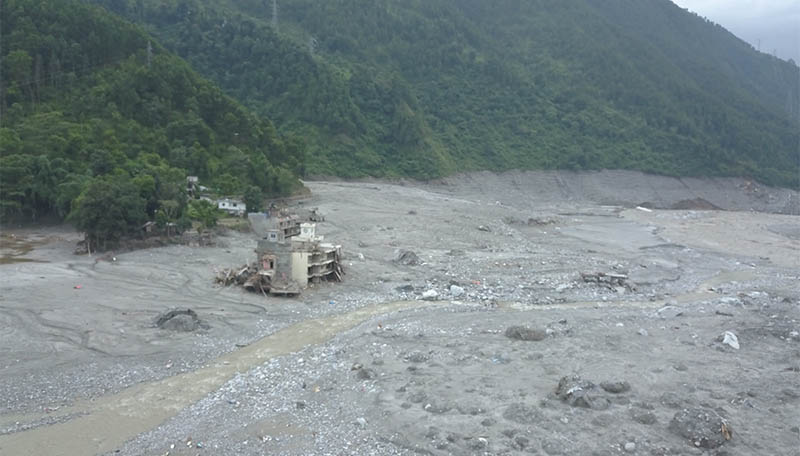
Dr. Shyam Acharya, who went to Rasuwa on behalf of the ministry for monitoring, stated that the lack of coordination between schools and local communities has made it impossible to determine the exact number of missing students.
He noted that there is no alternative to residential schools in Rasuwa. “The schools that suffered complete damage have low student enrollment. For them, establishing residential facilities at a nearby school is the most suitable option,” he said.
Residential facilities for affected students
Under Secretary Shyam Acharya, who led the team sent to Rasuwa, recommended providing residential schooling facilities at nearby larger schools rather than establishing temporary learning centers to resume the flood-damaged schools.
“If temporary learning centers are constructed, mud will seep in during the rainy season. Furthermore, the number of students is low,” he says. “There is also no possibility of constructing school infrastructure in the severely affected areas. Therefore, managing residential facilities at a nearby school is the most appropriate solution.”
In some schools in Rasuwa itself, more than half of the students are missing in the flood. Even those who survived have been displaced. At Nepal Rastriya Basic School in Timure, which was completely destroyed, 25 out of the 35 enrolled students are missing. Headmaster Phurba Dorje Ghale stated that the remaining 10 students have been displaced elsewhere.
Also read: Mud Everywhere, Bodies Left Uncollected, and Rescue Without a Rope
Malikadevi Basic School in Kuwapani, Uttargaya Rural Municipality-4, has been completely destroyed. Out of 18 students, 11 are missing and seven have been displaced, according to Headmaster Purna Bahadur Ghale. Under Secretary Shyam Acharya suggested that students from such schools should be transferred to other nearby schools.
He noted that students from Syabrubesi and Timure could be accommodated at Kumin Secondary School in Thulo Syabru. Since this school features a Himalayan hostel and teacher quarters, it can educate up to 2,000 students and accommodate up to 100 students in its hostel.
Schools unaffected by the flood stated they could teach additional students if the government provides support. “If a scholarship of 5,000 rupees per student is provided for 200 students, we can manage residential arrangements for flood-affected students,” said Madhav Lamichhane, Headmaster of Nilkantha Secondary School in Uttargaya.
He added that if the school structure proves insufficient, private houses with over 20 vacant rooms nearby could be rented for management. Given that direct contact has been cut off in areas where roads and bridges were washed away, he emphasized that there is no alternative but to offer residential facilities to students from those locations.
Deputy Mayor of Bidur Municipality, Prabha Bogati, stated that they are preparing an action plan to manage students from flood-swept schools by integrating them into other institutions in Nuwakot. “We will accommodate students who lack school infrastructure in another school with residential facilities,” she said.
Durga Prasad Chalise, Member Secretary of the National Child Rights Council, stated that coordination is underway with the relevant ministry to ensure no compromise is made on the rights of flood-affected children.
Noting that data received from local levels includes details of 102 children who have lost both parents, he said efforts are being made to identify more such children and manage them by setting up temporary shelter in Lalitpur. “We are prioritizing the identification and management of parentless children,” he said. “We have deployed staff to the field to assess their needs and determine how best to support them.”
Cover photo: A school bus of Modern Trinity English Boarding School swept away by the flood in Betrawati Bazaar. Photo: Rajneesh Bhandari/NIMJN.
Please adhere to our republishing policy if you'd like to republish this story. You can find the guidelines here.

Comments