
A decade after the 2015 earthquakes, more than one million houses were damaged. Due to slow progress in reconstruction, the dream of poor, disadvantaged, marginalized communities, and single women to live in resilient houses remains unfulfilled. A total of 92,000 beneficiaries who were affected by the earthquake are still waiting for their third installment.
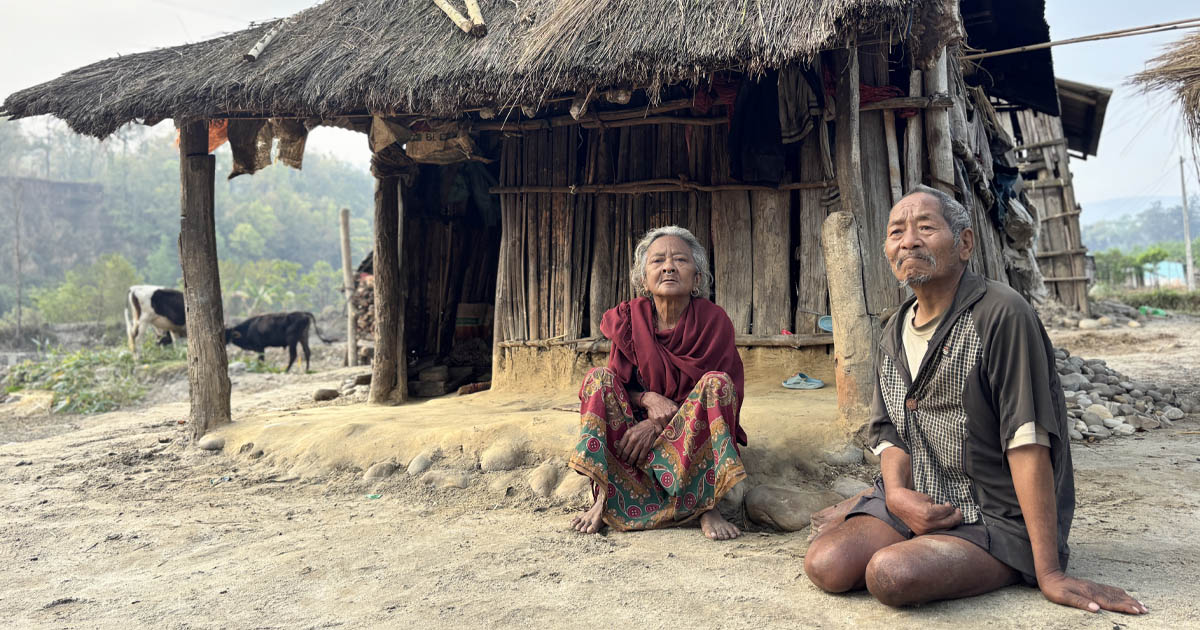
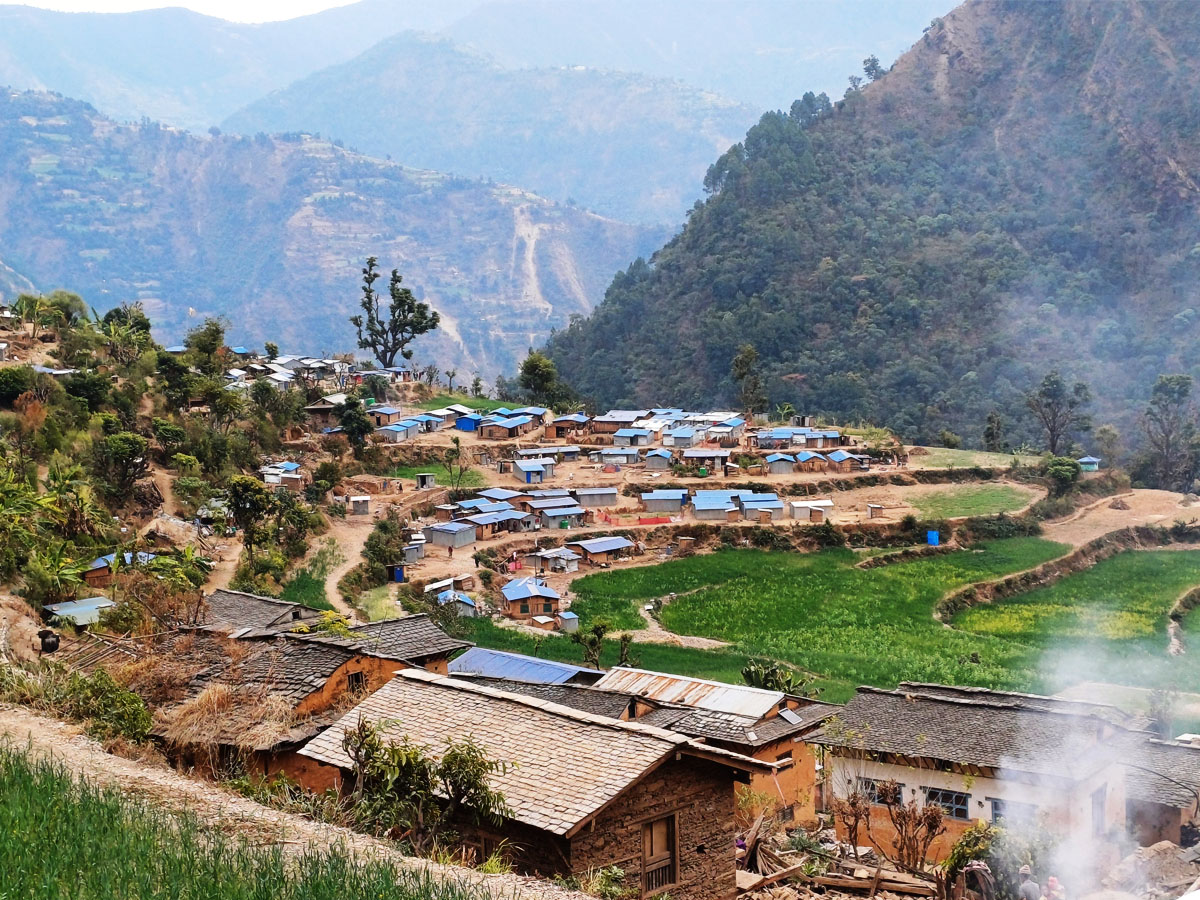
Sitamaya Chepang, from Maisirang, Raksirang-8, in Makawanpur, has been waiting to move into a new house since her home was destroyed in the April 25, 2015, earthquake. Although she received the second installment of a reconstruction grant, her house remains unfinished because she has yet to receive the third.
Currently living in a temporary shelter built by her neighbors, Sitamaya says, "Even if it is unsafe, I will live in my own house; where else can I go? There is no place to go."
She explains that her lack of income has prevented her from building a resilient house. "There is no money to build the house. The grant money of Rs 100,000 has not come yet. They say it will come soon, but I do not know whether it will," Sitamaya said.
Her son, Sagar, says that their complaints to the municipality have been ignored. "We have not been able to pay the carpenters and masons. We bought zinc sheets from Manahari Hardware on credit and we still have to pay for those," he said. "Before, engineers would come, prepare files and take them away. Maybe they have not submitted the files to the concerned office. We do not know what went wrong. They have stopped working and there is no sign of the office being active."
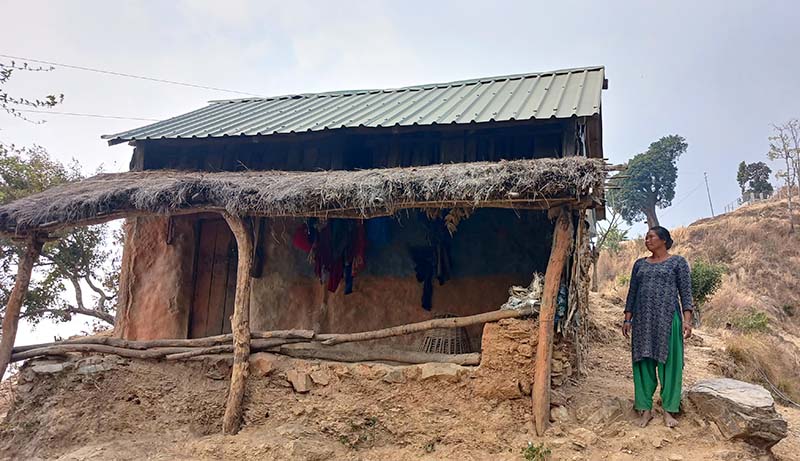
According to Sagar, who is also the chairman of Raksirang Rural Municipality from the Unified Socialist Party, many others in the municipality have yet to receive the final installment of their reconstruction grant. "We have complained to the municipal office many times about not receiving the third installment but the chairman and officers there say, 'There is no office or technician, so who would we ask for the money from?'" he said.
The National Reconstruction Authority (NRA), which was created for post-earthquake reconstruction, was dissolved on December 24, 2021. With its dissolution, the remaining reconstruction work lost momentum, leaving marginalized and poor beneficiaries like Sitamaya unable to finish building their houses without the final grant installment.
According to NRA data, 1,052,930 houses were damaged by the earthquake. The NRA reconstructed and retrofitted 914,950 of them. Its own data shows that 138,780 private houses still needed to be reconstructed and retrofitted when the NRA's term ended. The NRA handed over the remaining responsibilities to the Ministry of Urban Development. Currently, private housing reconstruction is handled by the Central Project Unit under the Ministry of Urban Development. According to Kishore Bikram Shahi, an engineer at the Central Project Unit, 92,000 completely damaged houses still need to be reconstructed, and 2,135 need to be retrofitted.
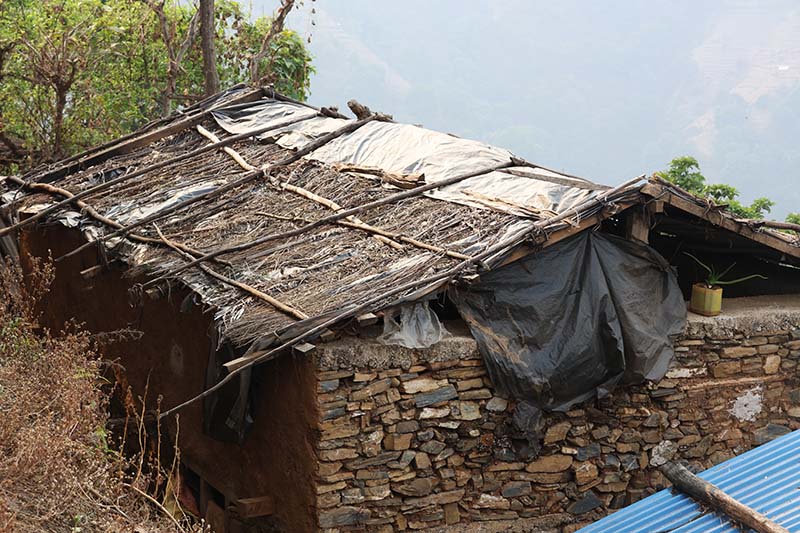
Baburaj Praja, 41, a resident of Raksirang-6, lost his home in the earthquake, which housed his six-member family. After two complaints, his name was finally added to the list of beneficiaries. He used the first installment of Rs 50,000 to lay the foundation and the second installment of Rs 150,000 to build the walls.
Unable to afford more, he has not been able to build a roof and has instead used a plastic sheet. "The third installment of Rs 100,000 has not arrived yet," he said. "Others have built their houses and it makes me sad that I cannot put a roof on mine."
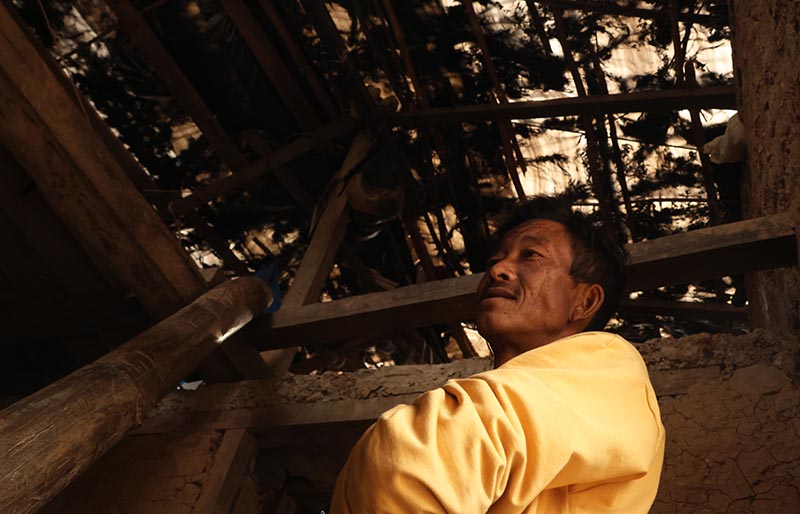
When we visited Baburaj's house in March 2025, his wife, Subimaya, was unwell. "There is no better place to live. I keep getting sick and I cannot do anything," she said, feeling hopeless.
The family has lived in the roofless house for five consecutive monsoon seasons. "The plastic roof does not stop rainwater from leaking. It is much more difficult during storms or hail," Baburaj explained. He has already replaced the plastic roof four times, buying plastic at Rs 400 per kg, needing three kgs each time.
Baburaj's brother-in-law and sister-in-law live in a separate house they built after the earthquake. Since it was not supervised by a skilled technician, the house is not earthquake-resilient. Five people live in this home, which was built through labor donation and exchange. Baburaj's sister-in-law, Alisa Chepang, says they have not been able to install windows and doors due to a lack of funds.
According to Ram Bahadur Praja, the ward chair of Raksirang-7, 33 earthquake victims have yet to rebuild their houses. He places more blame on the beneficiaries than on the state. "They are often content living under shacks. Some who received installments before Dashain squandered the money. We repeatedly told them to complete construction but it was useless," he said. "Three beneficiaries whose houses were completely damaged did not even sign the grant agreement."
Ram Kumar Thing, the ward chair of Raksirang-9, says beneficiaries often come to the ward office to complain about not receiving the grant. "Thirty percent of the beneficiaries have not received the third installment. They ask, 'Where will we get the installments for houses built on loans?' They tell us we have to take the initiative but where would we inquire? What should we do? There is total confusion," he said.
After the earthquake, the NRA deployed technicians to the affected local areas. These technicians were responsible for coordinating and overseeing all reconstruction-related work.
According to Ram Kumar, some genuine earthquake victims have been denied grants. "The names of earthquake victims from the Chepang community are missing from the list of beneficiaries," he said. "This might be because their houses are on the other side of the mountain, making it difficult for technicians to reach them."
Bhim Bahadur Pariyar, the former section officer at the District Project Implementation Unit (Grant Management and Local Infrastructure) in Hetauda, recalls that initially, grant agreements were signed with beneficiaries whose houses were on public land (elani jagga). However, the working procedure was later amended to specify that only those with private land would be entitled to grants, which caused problems with distributing the second installment.
"People had been living on public land in Bakaiya, Manahari, and Phaparbari for years. Their names were in the field book but they did not have land ownership certificates. Some had documents showing their house had been moved," Bhim Bahadur said. "Later, the grant distribution procedure required a mandatory land ownership document. So, even after receiving the first installment, they could not get the second."
According to him, a lack of technical knowledge and delays in inspections led to people building houses that did not meet the standards, which caused problems in paying the beneficiaries. "We found that even people with safe housing elsewhere were claiming grant money," said Bhim Bahadur. "Some came on their own to return the grant, while we forced others to do so."
Double whammy by Melamchi floods
To check on the status of private housing reconstruction, we visited the Model Majhi settlement in Melamchi Municipality-10, Sindhupalchok, on February 11, 2081. The Thai Nepali Association had built temporary homes in this village, then known as Arubote Majhi Village. The houses, which featured iron pillars, zinc roofs and plywood walls, were handed over to residents in March 2017. After this, the village was renamed the ‘Model Majhi Settlement’.
Despite the new name, the situation for the Majhi community remained the same.
Local residents say their temporary plywood homes are infested with mites and get soaked when it rains. However, they are grateful to have had shelter during the disaster. Of the 46 families who received temporary houses, four have not been able to build new permanent ones.
Ramkrishna Majhi's son had to undergo eye surgery while his father was trying to build a house, which prevented its completion. Dhruv Majhi's wife became ill, forcing him to prioritize her treatment over construction. Kanchhi Majhi is a single woman, and Geeta Majhi is frequently ill, which also hindered their ability to rebuild.
Kanchhi Majhi, who lost her husband before the earthquake, said she could not finish building her house because of a lack of money. "I received Rs 200,000 and am still supposed to get Rs 100,000. Maybe it was not given because the house was not finished," she said. "They kept saying they would give it but the house is not built, it has not been approved, and I have not gone to the district office either."
Leaning against the door of her temporary shelter, she pointed out that it was infested with mites. "Those who were resourceful demolished the temporary house and built an earthquake-resilient one but we have not been able to," she said. "It worries me when an earthquake hits because my house is not safe."
According to her, the government grant was not enough to build a house. "When there was money, there was not any cement or rods. A bag of cement costs Rs 1,200. Rs 300,000 is not enough to build a house. Things are so expensive!" she said. "They gave Rs 300,000 to everyone, regardless of whether they were well-off or poor. If they had given more money to the poor, we probably would have been able to build a resilient house."
Kanchhi says no one will give her a loan because she is a widow. "If my husband were alive, I would have built it anyway. When I ask for a loan, nobody gives me one, thinking I will not be able to repay it. If I had a field, they might give me a loan and take my field in exchange," she said, expressing the pain of not having a husband or property.
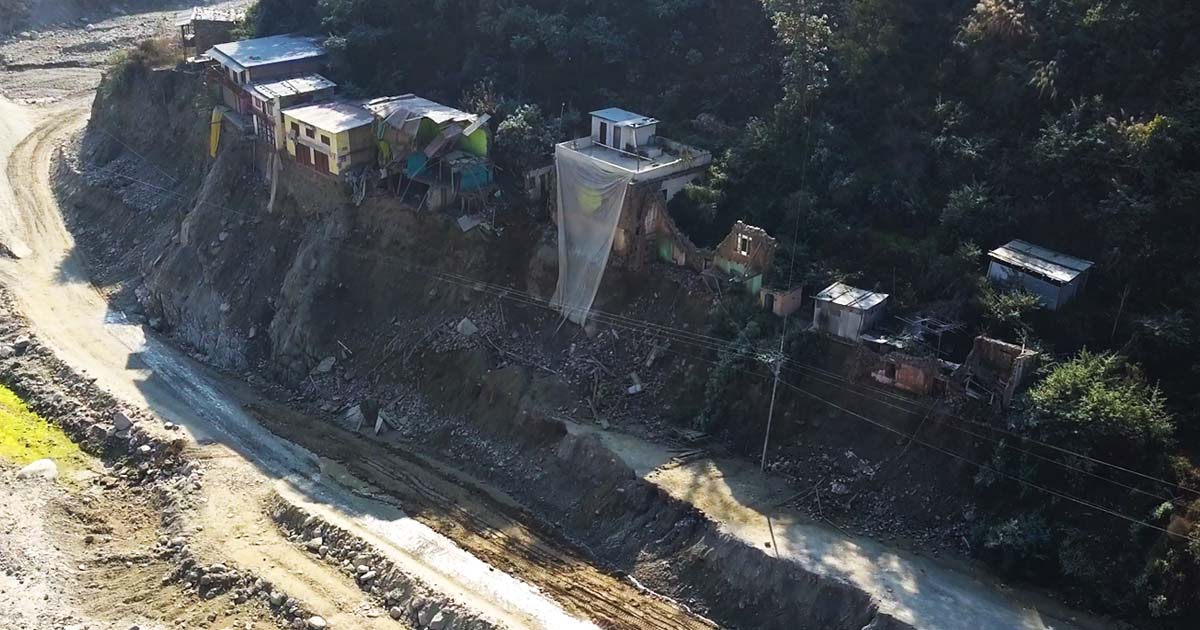
The flood in the Melamchi River on June 15, 2021, turned her arable land into a sandbank, worsening her poverty.
"We had a piece of land on the banks of the Melamchi River. The fields we used for farming, which grew 22 muris of rice, were destroyed by the flood," she said. "We used to sell rice to celebrate Dashain and Tihar, and when we had to travel, we would sell rice to cover the expenses," Kanchhi recalled.
Almost everyone in Majhi village lost their fields to the Melamchi flood.
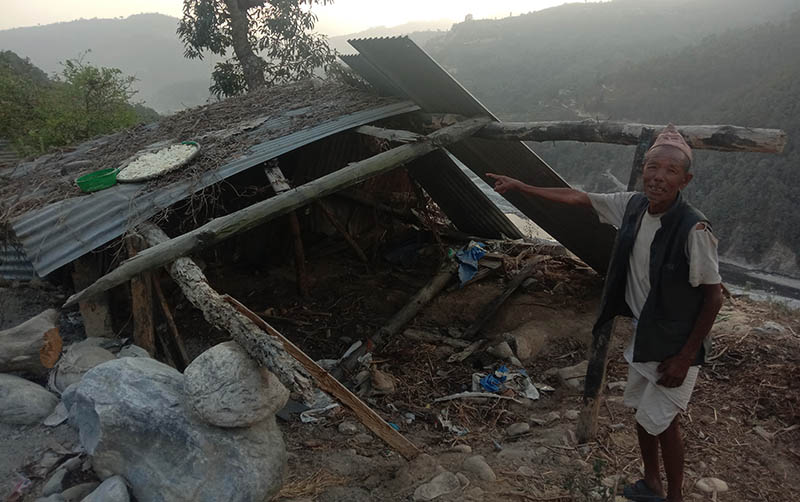
Dhan Bahadur Majhi, 73, said the Majhi village faced the double blow of floods after the earthquake. He lamented that nothing belonging to the Majhis remains. "Their wealth, the river and what was in it, the fish, there is nothing there," he said. "Ninety ropanis of land turned into a sand bed; no crops grow in the sand."
Geeta Majhi's house has no roof. "The doctor said my intestines were torn after my mouth bled, and I was treated in the ICU," she said. "The grant money was used to pay off my treatment debts, so I have not been able to complete the house construction."
Her husband, Bain Bahadur, sifts sand, and their son works at a crusher plant. She said it is difficult to cover household expenses for their family of six with their earnings.
Bishnukumari Majhi has built a new house but is not confident living in it because it lacks pillars. "At the time, pillars could not be installed, so fear creeps in now and then," she said. "If the government had not provided the grant, we would not have a house to live in but if it had provided more support, we would have been able to live in a safer house."
She built the house with the grant money, her savings and an additional loan of 100,000 rupees. She said she spent another 150,000 rupees to build a supporting wall to protect the house, as it is in a landslide-prone area.
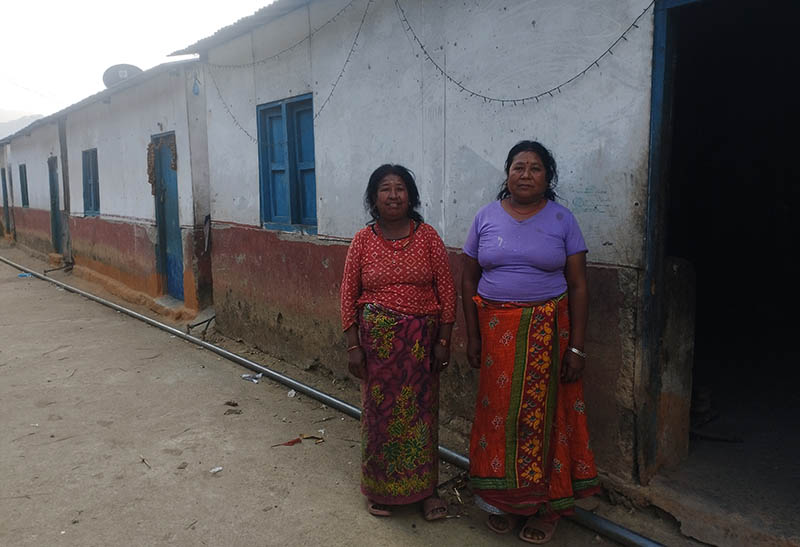
Suku Majhi, who built a house with the government grant, said that the 300,000 rupees he received was not enough even for building materials. "We built an earthquake-resilient house with the 800,000 to 900,000 rupees we had and our family of eight is living in it now," he said.
Krishnabhakta Shrestha of Melamchi Municipality-11, whose house is still incomplete, has a different story. According to his wife, Kabita Shrestha, the house is unfinished despite receiving all three grant installments. "My husband squandered the grant money. I sent him a loan of 400,000 rupees and instead of putting a roof on the house, he left after marrying a second wife," she said. "I weave carpets in Kathmandu. What am I supposed to do with my small income? Eat? Pay the rent and educate my children? Or build a roof for the house?"
Kabita, who says she has a total of 200,000 rupees in loans to repay, also complains that the house construction has not been completed because the government failed to monitor how the grant money was spent.
The performance audit report by the Office of the Auditor General, 2021, concluded that poor citizens were unable to build houses with the grant money, while wealthy families did not need it.
92,000 houses yet to be built
The National Reconstruction and Rehabilitation Policy (2015) declared that residential buildings damaged by the earthquake would be reconstructed as quickly as possible and that the homeless would be rehabilitated.
The National Reconstruction Authority (NRA) was established after the enactment of the Act relating to Reconstruction of Earthquake-Affected Structures (2015). The NRA's sectoral plan and financial projections aimed to complete the construction of private housing within two years. The then Prime Minister, Sushil Koirala, also announced that the reconstruction of private houses would be finished within that timeframe.
Initially, the government issued the Earthquake-Damaged Private Housing Reconstruction Grant Distribution Procedure (2015), which provided a grant of only Rs 200,000.
This was later superseded by the Grant Disbursement Procedures for Private Houses Destroyed by the Earthquakes (First Amendment) 2016, which increased the grant to Rs 300,000. Schedule 1 of this procedure outlined the criteria for selecting beneficiaries for the earthquake-damaged private housing reconstruction and retrofitting grant.
Section 5 (c) of the procedure specified that the grant would be disbursed in three installments: Rs 50,000 as the first, Rs 150,000 as the second, and Rs 100,000 as the third.
It also stipulated that the first installment would be released after beneficiaries were on the list, opened a bank account and signed an agreement. The second installment would be provided after the house's foundation was laid and certified by a technician and the third would be disbursed after the roof was completed and certified by a technician.
Section 3 of the procedure, which outlines beneficiary identification, states that individuals or families without a residential building elsewhere can also be beneficiaries.
The government's initial mandate for the National Reconstruction Authority (NRA), formed on December 25, 2015, was until November 30, 2020, but its term was extended by one year to December 25, 2021. The authority was dissolved without completing private housing and other reconstruction projects. A total of 835,185 beneficiaries were identified for private housing reconstruction.
According to the 61st Annual Report of the Office of the Auditor General (OAG) for 2024, the government has paid the first installment to only 834,024 beneficiaries, the second to 768,759, and the third to 736,745.
Of these, 65,265 beneficiaries who received the first installment, totaling Rs 3.26 billion, have not received the second and final payments. Additionally, 32,014 beneficiaries who received the first and second installments have not received the final one.
The OAG has recommended monitoring to ensure that grant money is used correctly by beneficiaries who have received the first and second installments but have not completed their homes.
The OAG's 2022 performance audit found that grants were paid but houses were not built. The audit shows that in nine local areas, 82 beneficiaries who received all three installments had not started construction, 16 beneficiaries had been paid two installments, and 41 beneficiaries who had only completed the foundation (DPC) were paid the third installment. These payments totaled Rs 39.9 million, violating the grant procedure.
The report states that while such situations are likely in all areas where the earthquake grant program was implemented, the OAG couldn't include every case due to a lack of time, human resources and access to information.
"Although the World Bank's third-party monitoring also cited such examples and recommended action, the NRA was not found to be conducting extensive monitoring seriously," the report said.
The report noted that these irregularities emerged from a lack of effective oversight, even though monitoring and evaluation experts were present in the NRA's Central Project Implementation Unit, Housing and Central Project Implementation Unit (Grant Management and Local Infrastructure), and District Project Implementation Units.
According to Kishore Bikram Shahi, an engineer at the Central Project Implementation Unit, which is currently handling private housing reconstruction, grant agreements had been signed with 834,821 beneficiaries by mid-January 2025. Of these, 834,267 had received the first installment, and 770,775 had received the second.
A total of 743,249 beneficiaries have received the third installment. The Unit's statistics show that reconstruction for all who received the third installment is complete.
Retrofitting grant: From little to none
Located 25 kilometers from Bhandara in Chitwan district, Darang village is home to poor Chepang hill communities struggling with poverty. According to Prem Maya Chepang, of the 28 households whose homes were partially damaged, 18 have not received the retrofitting grant. Six households with completely destroyed homes received the full grant, but four of those houses are still unfinished. "Even those whose house walls collapsed and who built a makeshift wooden wall for protection have not received the grant," she said.
The NRA had planned to disburse Rs 100,000 to each household with a partially damaged home for retrofitting. Mangalsingh Chepang, 40, from Raksirang-7, Darang, was supposed to receive Rs 100,000 but did not, and he has been unable to retrofit his house due to a lack of funds. "The earthquake cracked my house, and the roof broke down," he said. "They had taken a photo of the house, but I never got the money." He hopes the government or another organization will provide support so he can build an earthquake-resilient home.
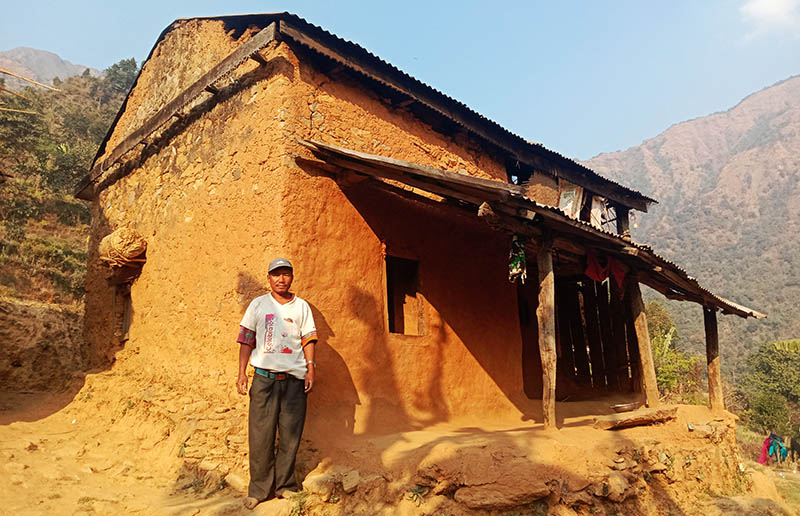
As per Section 5(1) Schedule-1 of the Private Housing Grant Distribution Procedure (2017), beneficiaries are eligible to receive a retrofitting grant. This procedure allows beneficiaries to get a Rs 100,000 grant in two installments of Rs 50,000 each. The 2015 Gorkha earthquake partially damaged 298,998 houses, and the government had promised to provide a Rs 100,000 retrofitting grant for each. However, according to the 2020 performance audit report, only 78,031 households were retrofitting beneficiaries. Of these, retrofitting agreements were signed with just 31,770 beneficiaries, who, according to the Unit, received both installments after signing.
Beneficiaries have not been interested in the retrofitting grant due to concerns that Rs 100,000 may not be enough to retrofit their houses and that the retrofitted houses might not be earthquake-resilient.
The 2020 performance audit report noted that over 50 percent of retrofitting beneficiaries wanted a change in the reconstruction modality, many had to demolish their homes, and very few retrofitting projects were completed. The Office of the Auditor General believes the problem arose because buildings that did not need to be retrofitted, could not be retrofitted, or had to be demolished were designated as beneficiaries. The grant amount of Rs 2.22 billion could not be used as intended, as retrofitting beneficiaries who received the first installment did not complete the retrofitting work.
Manju Tamang, a former resident of Churiyamai VDC-5, said she received the first installment of the retrofitting grant, Rs 50,000, but not the second. "The earthquake had caused cracks in the walls of my house. I received Rs 50,000, with which we did some repairs and moved in," she said. "Since we didn't receive the second installment for four years, we tore down the house and built a new one ourselves." According to her, many people in the village received the first installment but never the second.
Kumarimaya Tamang of Kailash VDC-7 is another beneficiary who faced the same situation.
Dramatic rise in beneficiary number
A survey in the affected districts right after the earthquake initially determined the number of beneficiaries at 531,964. After further confirmation, the need to reconstruct 726,705 houses was identified, with 41,000 households later added to the reconstruction process. The Post-Disaster Needs Assessment (2015) reported that a total of 755,549 private houses suffered damages – 498,852 were fully damaged, and 256,697 were partially damaged. This was the preliminary data collected a month after the earthquake.
The earthquake caused greater damage and loss to houses made of bricks, stone, and mud, as well as to old and technically weak houses with weak foundations. The book Gorkha Earthquake 15: Experience and Learning, published by the Disaster Management Division in 2016, states that a total of 1,072,093 private houses were damaged by the earthquake. Of these, 773,095 were completely damaged, and 298,998 were partially damaged. This data is from April 23, 2016.
Later, the total number of beneficiaries was determined to be 909,536, after combining the findings of two surveys conducted in 2016 and 2017 and addressing grievances as of March 27, 2020.
The now-defunct NRA's final statistics state that a total of 1,052,930 houses were damaged by the earthquake, and 914,950 houses were retrofitted.
After the earthquake, it became common for family members to be listed as living separately in order to receive more relief materials. Even people living abroad who did not own homes in Nepal began applying for reconstruction grants. The Performance Audit report called the 71% increase in beneficiaries from the initial survey "unnatural." On-site surveys conducted by the Office of the Auditor General (OAG) found that unmarried sons, married women, husbands, wives, and even parents who were part of the same family unit were listed as separate beneficiaries.
Not all houses in the 31 earthquake-affected districts were destroyed. However, an OAG study, which compared the number of beneficiaries to the projected number of households from the Central Bureau of Statistics for 2021, found that more houses were damaged than the number of households projected for 2021.
"For example, in Dolakha, where there was a 17.89% increase in households over 10 years, there was an 86% increase in just four years from 2011 to 2015, while the number of damaged houses increased by 41% from the initial survey," the Auditor General’s performance audit report states.
The NRA's own data shows there were 91,059 beneficiaries for 88,741 houses destroyed by the earthquake in the Sindhupalchowk district.
On average, it took beneficiaries a maximum of 827 days, a minimum of 12 days, and an overall average of 67 days after signing the agreement to receive their first installment. According to the report, it took an average of 94 days, 21 days, and 54 days for a beneficiary to receive the first, second, and third installments, respectively. The maximum waiting times were 1,976, 677, and 467 days, respectively. In 2016, the average time for the payment process at five local levels was 47 days, but this period has been gradually increasing in recent years.
The Office of the Auditor General concluded that the grant disbursement system is not user-friendly because the process starts too late, causing beneficiaries to not receive the grants on time.
Grant over loans
Through the Refinancing Procedures for Reconstruction of Private Houses (2015), the government provisioned loans and interest grants for earthquake-affected households. The loan grant was intended for households without livable homes, allowing them to borrow up to Rs 2.5 million in the Kathmandu Valley and Rs 1.5 million in other affected districts. However, these facilities were not widely used.
Compared to those who took grants, very few people took advantage of this two-year loan at a 2 percent interest rate. The Auditor General's Report from 2017 states that only 659 people took loans, totaling Rs 1.28 billion.
According to Suman Neupane, Information Officer of Nepal Rastra Bank, loans worth Rs 3.25 billion were mobilized over four years, from the fiscal year 2015/16 to 2019/20.
In 2017, the government also created "Procedures for providing interest-free loans in collective collateral for the construction of houses of the earthquake victims." The budget for the fiscal year 2017/18 announced an additional interest-free loan of Rs 300,000, available under collective guarantees for the construction of victims' houses.
This loan, which was available to households with beneficiary cards, never went into effect.
On September 6, 2018, the government repealed the previous procedure and introduced the Unified Procedure on Interest Subsidy for Concessional Loans, 2018 (Third Amendment). This new policy was aimed at earthquake victims who were unable to sign reconstruction agreements with the NRA or who, despite having an agreement, had not received their second installment and could not rebuild due to financial hardship. This new procedure offered a loan of up to Rs 300,000 for five years to build private houses. There was a provision that banks could not charge an interest rate exceeding two percent of the base rate, and some beneficiaries have taken advantage of this loan facility.
Grant was not needs-based
Article 51 of the Constitution of Nepal aims to ensure that the general public benefits from development fairly, with priority given to indigent citizens. However, when identifying beneficiaries, individual and family financial capacity was not considered for grant distribution.
Because of this, Goma Majhi, a poor woman from the marginalized Majhi community in Melamchi Municipality-10, received the same grant amount of 300,000 rupees as wealthier, affected families. The Rs 300,000 was not enough for Goma to build her house. Even after taking out an additional 100,000 rupees in loans, the house was not completed. "I had to pay 16,000 rupees for a single trip of sand. Cement, rods, and other construction materials are also expensive," she said. "Including the grant, 400,000 rupees have already been spent, and I still have to plaster the walls."
The housing grant was distributed based on citizenship from the affected districts, not on the number of family members or financial need. The procedure required beneficiaries to provide a copy of their citizenship certificate, a landowner registration certificate, a collective field document, or a document from the Central Bureau of Statistics collected during the reconstruction data collection. The Office of the Auditor General (OAG) performance audit (2000) highlighted that the grant distribution was not need-based. The report stated that Rs 300,000 was given to every affected beneficiary, whether they were poor or rich.
The Office of the Auditor General has concluded that poor citizens were unable to build houses with the grant money, while wealthy families did not need it.
In line with the spirit of the constitution, public resources should be used to their maximum potential, with priority given to poor citizens. The Office of the Auditor General recommended that economically weaker victims be given greater priority to make the reconstruction program more flexible and targeted.
Who is to blame?
Despite Nepal being a highly seismic region due to its geography, experts say both the state and its citizens made mistakes during post-earthquake reconstruction. Disaster expert Dr. Min Bahadur Paudyal Chhetri stated that although the government spent a lot of money on reconstruction, the results were not as expected. "The standard of a three-room house was recommended," he said. "The recommendation should have been based on family size."
He noted that families can have anywhere from two to eight members, so the housing standard set for the grant was not suitable for larger families. "On-site observations in the Melamchi area showed that because there isn't enough space for people, some have used the reconstructed houses for storing fodder or keeping livestock."
He said he has seen that eco-friendly houses were not built in many places, and people are living where they don't want to. "Some are still in makeshift huts, others haven't built their houses yet, and even those that are built aren't very useful," he said.
Dr. Min Bahadur also mentioned that people in remote rural areas built houses with government grants but then abandoned them to move to cities. "The trend was to not leave the Rs 300,000 government grant unused; people built a house and then left it," he said. "The grant was not used properly."
Dr. Ramesh Guragain, Executive Director at the National Society for Earthquake Resistance, who closely monitored the reconstruction process, says the government failed to consider citizens' financial needs when designing houses. According to him, the reconstruction grant may have been adequate for rural areas but was insufficient for urban areas. "Rs 300,000 was not enough for places where building a house would cost around six or seven million rupees," he said.
Architect Sapna Shakya says the government failed to make good use of indigenous technology, local resources, and techniques during reconstruction. "The design of houses built in Melamchi and Helambu in Sindhupalchowk is different. Strong houses can be built using local resources and architecture," she said. "This kind of work isn't possible through institutional efforts alone. The state should create a policy. A great opportunity to build traditional earthquake-resistant houses has been lost because of the state's lack of sensitivity."
She is concerned that the use of cement, sticks, and zinc sheets, even in remote areas, has disfigured settlements that once had traditional and unique identities.
Infrastructure expert Dr. Suryaraj Acharya says the reconstruction process has not been completed because there was not enough preparation to carry out the plan. "If we had done our homework diligently for the first three months, all the houses could have been built in six months. We failed on strategy," he said. "Foreign loans increased because we couldn't tell donor agencies what we actually wanted."
‘It is unfair to highlight only the 5 percent gap, when 95 percent of the work was accomplished.’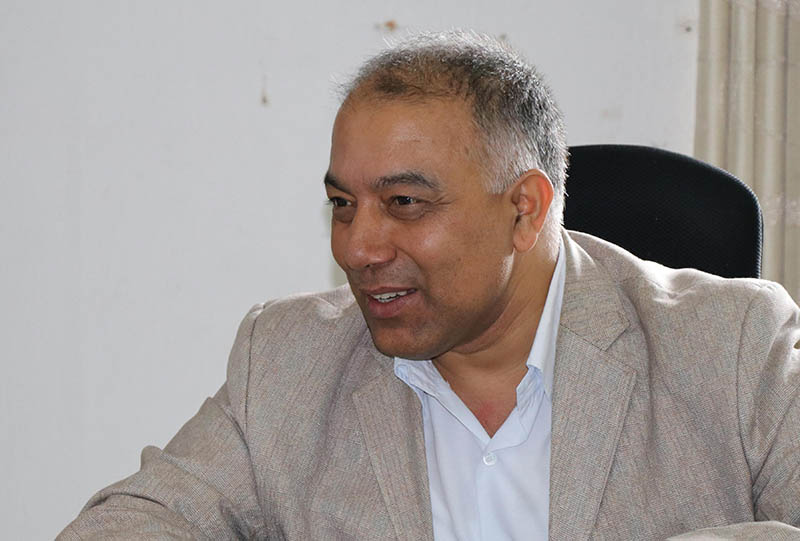
Sushil Gyawali
Former Chief Executive Officer, National Reconstruction Authority (NRA)
Some poor, earthquake-affected people haven't received their third installment or couldn't build houses at all. Where did we fail?
A large number of houses have been rebuilt. If you have the exact figures for the cases you mentioned by district, we would know precisely where that has happened.
But the government data shows 92,000 houses could not be rebuilt!
Some numbers may have been missed due to the large-scale nature of the reconstruction work. The 92,000 data also includes people who didn't need to build houses but took the grant money, as well as those who had homes in other places and took the grant but didn't use it. It is also possible that marginalized communities could not rebuild due to financial constraints. We launched a program in coordination with the World Bank and other NGOs to include these communities in the reconstruction process.
A total of 900 carpenters and masons were trained and mobilized during the reconstruction period. We also provided an additional Rs 50,000 in assistance and material support in some cases.
It is unfair to highlight only the 5 percent gap, the things that couldn't be done for various reasons, when 95 percent of the work was accomplished. We should also point out where we succeeded.
Why have houses not yet been built among the Chepang and Majhi communities?
That makes for a case study. If the total number of houses was 1,000, you need to look into how many were built, how many were not, why they were built, and why they were not. That gives a clear picture.
The reconstruction process takes longer with poor communities. First, they need to be prepared because they lack awareness. The first installment happened to be disbursed right before Dashain. When they received the money, they spent it on festival celebrations. In other cases, a husband would get the money and spend it himself instead of giving it to his wife. The second installment could not be given to such beneficiaries without them first completing the construction work that the initial grant was meant for.
There were special programs for the poor, but after the first installment was disbursed, we realized we should have been continuously coordinating to ensure the money was not spent elsewhere.
In your view, what factor may have caused the unnatural rise in the number of beneficiaries?
The number increased because people submitted complaint forms. When an investigation found the complaints to be valid, the grant had to be given to anyone who met the beneficiary criteria. At the time of the survey, there were no elected representatives at the local level, so we had to work with local residents, which may have contributed to the discrepancies. We did, however, implement a complaint process and even formed an appeal committee.
How did the changing leadership of the NRA impact reconstruction efforts?
It might have been possible to conduct regular monitoring immediately after giving grants to beneficiaries. Changes in the NRA's leadership certainly had an impact. These changes likely affected the plan to complete the work on time and the monitoring that needed to be carried out.
The reconstruction of all private houses was supposed to be completed in two years. Why has it not finished even in 10 years?
It would not have been possible to complete the reconstruction in two years. That timeframe was for completing the preliminary works. The overall time limit was six years, during which we worked even by extending the NRA's term. We had to set a time limit to ensure financial and technical support, human resource production, and the availability of construction materials.
Could we have segregated beneficiaries into poor and rich and provided more support to the poor?
We provided an additional 50,000 rupees to poor beneficiaries and extra support in remote areas and for the most deprived communities. Amid a lack of awareness among beneficiaries, we had to provide technical support and distribute grants simultaneously while also managing human resources and raising awareness among poor communities. We also failed to devise a proper modality. Even beneficiaries whose houses were on a hilltop, 25 kilometers from the base, received only 300,000 rupees.
You say the poor were given additional support, but on the field, there are people who haven't received the grant. Why didn't they get it?
We have it in our records. To find the answer, we need to understand why only 17 out of 20 houses were built in the Chepang settlement. It is necessary to motivate those who are reluctant to rebuild their houses.
But how can we leave citizens in precarious houses by saying that they are unwilling to build new ones?
It is not about leaving them behind. It seems we need to launch a separate program to raise awareness among such people. We implemented this in several stages, but we needed more time for such programs in urban areas and for the poor, which was not possible.
It is said that the reconstruction period was an opportunity for us to improve house design and preserve our original architecture, but we lost that opportunity.
We worked based on the principle of core housing. We cannot expect beneficiaries to rebuild their houses while retaining the architecture and designs that we like, especially with a grant of only 300,000 rupees. Now, in villages, people have started to add a loft above their two-room houses and build pantries and kitchens. This has become a campaign.
This is how houses were built in the past. People did not have all the money at once; they would build one story and add on later. That campaign is now underway. With the Rs 300,000 grant, earthquake-resilient houses have been built under the core housing model. We asked people to install traditional windows, and they did. Now, people have started to build additional props and indigenous (maulik) roofs. We are slowly returning to originality.
‘There are economic and social reasons why the houses have not been rebuilt.’
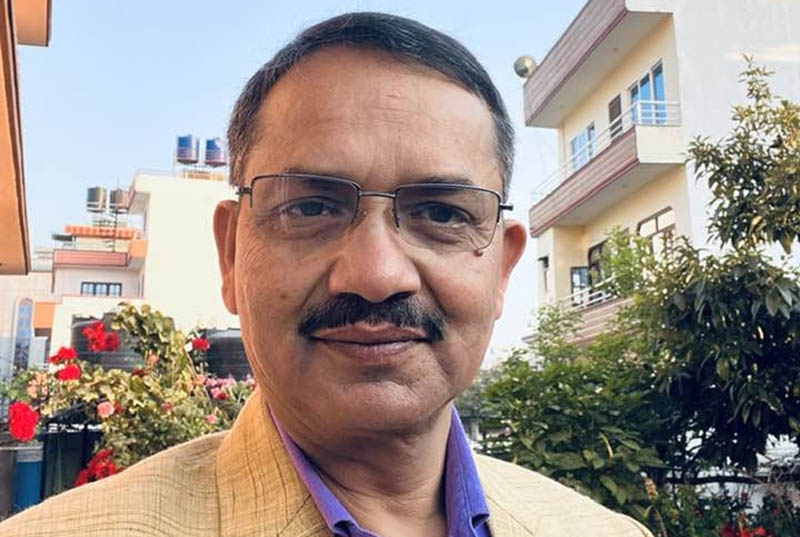 Dr. Govinda Pokharel
Former Chief Executive Officer, National Reconstruction Authority
According to government data, 92,000 houses are yet to be built. Where did we fail in the reconstruction process?
No country can rebuild 100% of the houses damaged in a disaster, regardless of how many beneficiaries are identified or how many houses collapsed. This is because some people migrate, others cannot afford to rebuild even with the Rs 300,000 grant, and some who had two houses didn't feel it was necessary to rebuild the one that collapsed.
Could we have given more to the poor when distributing grants?
Yes, they could have been given more. However, it is difficult to distinguish between the poor and the rich in Nepal. Engineers also have poverty cards. Even those who already had a house took the Rs 100,000 grant. In villages, some who did not need a new house built a basic one with the Rs 300,000. There are many such cases. People with two houses who lost one rebuilt it and retrofitted the other. Others did not need to build a new house and moved elsewhere. Some built a house with only Rs 300,000. People may also not have built houses because the budget of Rs 300,000 was insufficient to cover the costs of masons. For example, they may have laid the foundation with the first Rs 100,000 installment and then run out of money. The elderly, disabled, poor, families with land disputes, and those living on Guthi land faced more problems. There are economic and social reasons why the houses have not been rebuilt. Some people couldn't rebuild because there was no one to take the lead for them. We had made arrangements to give an additional Rs 50,000 if an NGO built a house for such people. There may be various reasons, such as the need to build a house according to specific standards and people's inability to comply with them.
But the poor and the needy bear the brunt of it all, don't they?
Yes, they do. That is why we took the step of having NGOs build houses for the extremely poor. NGOs have built houses for the extremely poor in some places, but they haven't been able to reach all hard-to-reach areas. Some poor people have not built houses because of land issues or because they have no one to build them. Some beneficiaries are single women or the elderly. Others did not need to build houses in the first place and may have taken the Rs 100,000 grant to see if they could spend it without building a house, which is illegal.
When you left the NRA, you said reconstruction work could be entrusted to bureaucrats. Why has it not been completed yet?
When I became the CEO of the NRA for the second time, all procedures had been finalized. My first tenure was only 12 days, during which I could only set up the NRA office. When I returned, I advocated for entrusting grant distribution to local governments. The method of assistance had already been fixed, and we could only add more dimensions to it.
If I hadn't taken up the responsibility the second time, the Singha Durbar would have likely collapsed. I arranged an additional grant of Rs 50,000 to build traditional-style houses in six settlements, including in Sankhu, Bungamati, the Gorkha Durbar area, and the Dolakha Durbar area.
Why was there a tendency among people to use cement, rods and zinc, rather than local resources and traditional technology to rebuild houses?
When people in the city said that cement makes a strong house, people in remote areas also believed it. In Dolakha, when I told people that a strong house could also be built with stone blocks, they asked me what kind of house I had in Kathmandu. Most people built a single-story house with four-inch walls and covered it with a zinc sheet roof. Building with stone blocks would have been expensive, so they built with the Rs 300,000 grant, using whatever materials they had.
Why was the loan program not a priority? Loans would have given beneficiaries a sense of responsibility.
The loan issue was politicized. They announced that all banks, whether government or commercial, would provide loans at a 2 percent interest rate. No bank was willing to do this. Private banks wouldn't agree unless the government subsidized the remaining interest, and government banks also wouldn't agree to the 2 percent provision. In urban areas, it makes sense to take out a loan of two to four million rupees to build a house, but in villages, who would go to such trouble for a loan of two to three hundred thousand rupees? The idea of giving loans at a 2 percent interest rate could not be implemented because of this. It was proposed to allow banks to charge their normal interest rates and give a five percent interest waiver to beneficiaries. That was also estimated to incur a large investment. So, the loan scheme became a political slogan but was never implemented.
Please adhere to our republishing policy if you'd like to republish this story. You can find the guidelines here.
Comments