
Five people set themselves on fire in Nepal in July. Some are now reading the deaths as political in a country whose citizens are asking whether, one year after its Gen Z revolution, anything has changed.
Ganesh Nepali, a 25-year-old ride-hailing driver from a marginalized Dalit community in Nepal’s Mugu district, left home early on the morning of July 9 and told his brother to cook beans and goat trotters for when he returned. 
But he never made it home for the meal. Hours later, he set himself on fire outside the Department of Passports in Kathmandu after municipal police wheel-locked his motorcycle over a parking violation, which carries a Nrs 1000 ($6.5) fine. He died the next day at Bir Hospital.
Nepali had been worried about money lately and was looking for job opportunities, his brother Madan Nepali told NIMJN.
The following day, an educated but unemployed 35-year-old named Bibek Mandal from southern Sarlahi district set himself on fire and was airlifted to Kathmandu with burns covering 85% of his body. He died several days later.
"He applied (for jobs) everywhere, but because he didn't have money, he was rejected," his father Upendra Mandal told NIMJN, adding that his son had also been under stress from a large loan.
Before the end of the month, three more were dead.
Police have determined all five of these cases to be self-immolations and are still investigating the circumstances of the deaths.
In the meantime, some activists in Nepal are reading the spate of tragedies as a sign that the country’s new government is failing those on society’s lowest rung.
What has grabbed attention is not just the high number of self-immolations, but the speed and the timing: five deaths in under three weeks, and nearly one year after a Gen Z-led revolution ushered in new leaders who have promised to rid the country of corruption and reverse its long history of underdevelopment.
At least three of the five who died in July had been struggling economically, according to their families and police who are investigating these cases.
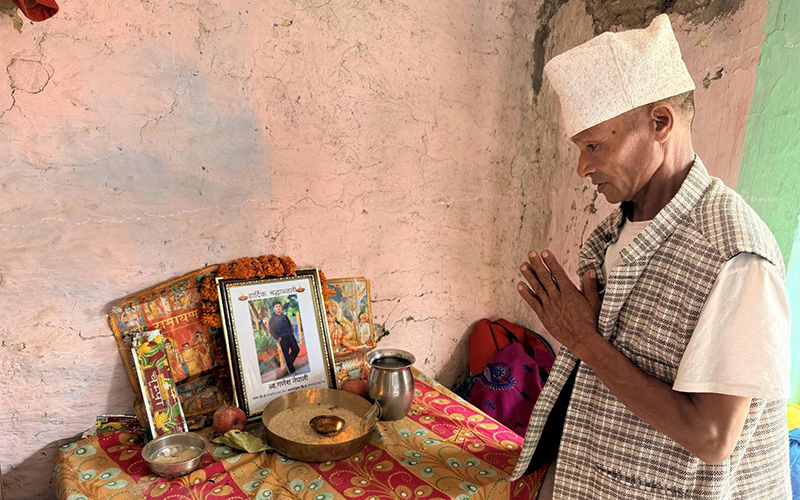
This has prompted activists to ask whether the country’s new leaders have done enough to tackle the pernicious inequality that fueled last year's protests, which Nepali — the first to die in July — had taken in part in himself, his brother told NIMJN.
The demonstrations were led by young Nepalis fed up with watching a series of high-level corruption cases unfold at the top echelons of their government while those at the bottom struggled to survive.
Tanuja Pandey, a Gen Z movement leader, noted that recent self-immolations involved “mostly working-class people, individuals running their own small businesses, or people placed at the very bottom of society's historical hierarchy.”
"I think this points to a failure of the government, not just this current government, but a historical failure. There is massive frustration among the people, and they see no way out."
Sociologists warn against collapsing the recent suicides into one cause, with the precise psychological and social drivers behind each case still the subject of investigation.
But they also note that in Nepal, a public burning is never read as only a death.
"The act of immolation is also an act of protest," said Pranab Kharel, a sociologist associated with the Kathmandu research institute Martin Chautari.
"The person committing that act is also making a strong political statement by using their own body to express the feeling that the person has, a feeling of unhappiness or anxiety or whatever that may be. So it is both a protest and, therefore, it is also political."
Spokespersons for the Government and Prime Minister's Office did not answer questions about whether the self-immolations were a sign of a broader failing on the government’s part.
A spokesperson for Kathmandu’s police stressed there are always “multiple factors” that drive a person to commit such an act.
“There are things the state must do, and things society must do” to address these underlying causes, Superintendent of Police Dan Bahadur Thapa told NIMJN.
"There can be a gap between the state's capacity — in terms of education, health, employment, and the economy — and the citizens' expectations. Bridging that gap is important.”
‘An act of protest’
Within hours of Nepali’s death, a video of his final minutes circulated widely on social media, and the incident became a topic of heated discussion in parliament.
"Is the government for those who earn a living through hard work, or for the affluent?" opposition lawmaker Khadga Shahi said in a July session, accusing the government of driving a working man to his death.
Home Minister Sudhan Gurung, a former DJ who has overseen the arrests of nearly a dozen high-profile politicians since taking office, rejected the charge and pointed the finger at the opposition.
The officers who locked Nepali's motorcycle belonged to the municipal police in a city and provincial government led by the opposition, he told parliament.
"You hold two levels of government — did we make these rules and laws? You made them," he said.
The total number of self-immolations that took place in July account for more than a third of all such incidents recorded in the year prior.
Dr. Rishav Koirala, a psychiatrist and researcher at the Brain and Neuroscience Center Nepal, stressed the need to examine each case individually.
“If you look at the trigger, say a 1,000-rupee fine, yes, that trigger happened. But we can't just say they committed suicide only because of that. We need to know their background, what hardships they were facing, what their mental state was."
Kharel also cautioned against expecting any government to fix in months an issue that has been decades in the making.
"To expect that in three or four months a government will use a magic wand to change the situation is, optimistically, fanciful, and pessimistically, a foolish idea," he said.
Nepal is one of South Asia's poorest countries, with about a fifth of its population living below the national poverty line, and an economy mostly supported by remittances from workers abroad.
It was in this context that a steady drumbeat of corruption scandals over the years — plus the sight of politicians and their children flaunting lavish lifestyles — sent young Nepalis facing joblessness to the streets, culminating in last year’s revolution.
Kharel noted that for many in the country, a sense of “collective anxiety” has been accumulating over decades, starting with Nepal's long postwar transition, through to the pandemic and the uprising itself.
"Gen Z gave a lot of hope, but Gen Z also dashed a lot of hopes," he added.
"A lot of businesses were burned down, individual homes were targeted, people were killed,” he said in reference to last year’s demonstrations, which turned violent after security forces used lethal force on the protesters, ultimately leading to the deaths of 76 people.
Promises unfulfilled
After Nepali's death, the national government and Kathmandu Metropolitan City signed a nine-point agreement with his family that was negotiated in the chief district officer's presence.
The document, reviewed by NIMJN, promised an independent investigation that would file a report within seven days; the suspension, pending its findings, of the municipal police officers deployed at the scene; a job for Nepali's wife; cover of his daughter's education through higher studies; financial relief; funeral and mourning costs; and health insurance for the family.
A month later, much of it has yet to transpire.
The investigation report has not been released by the Ministry of Home Affairs, who told NIMJN it had forwarded the investigation committee's recommendations to the health ministry, provincial, and local governments for implementation.
"You should ask the Metropolitan City about that," ministry spokesperson Ananda Kafle said on August 24. "The Metropolitan City was supposed to handle it by holding a board meeting... I haven't taken any updates on that since."
Contacted on the same day, Kathmandu Metropolitan City spokesperson Nabin Manandhar said he was unaware of any written instruction from the Home Ministry.
He told NIMJN in an earlier interview that the city said it had not received any suspension directive to the municipal police.
Asked whether the incident had changed anything about how the municipal police operate, Manandhar pushed back: "Has this happened because of the City Police? Do you think this happened because of the City Police?" As spokesperson, he added, "I have to defend them."
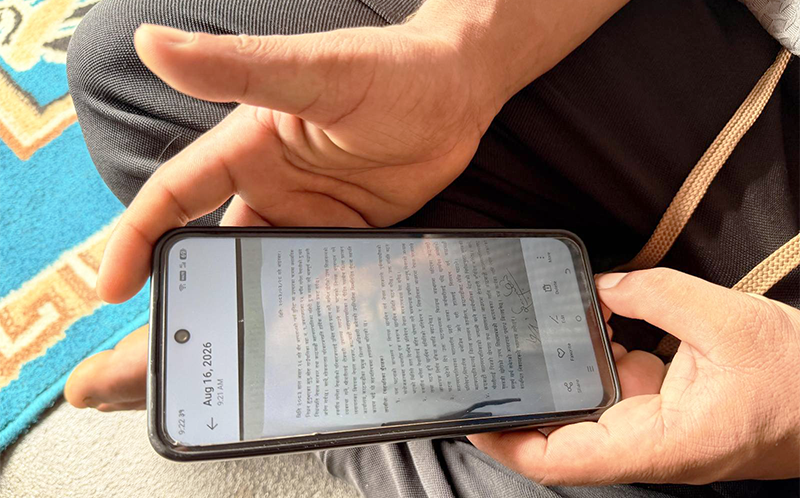
Meanwhile, Nepali’s relatives said they had not received the promised compensation and job, and that they will refuse such help until the report into Nepali’s death is made public and acted on.
"We desire that the agreements are implemented," Madan said. "Only after that happens do we feel it's appropriate to pursue other matters."
If the investigation is buried, Madan says the family is ready to take extreme measures.
His parents, he told NIMJN, have made their own grim vow: "'The two of us will go right in front of the government, where they can see us, and we will hang ourselves and die.'"
Of the nine points the government signed, the only other promises that have been delivered so far were the government’s handling of Nepali's cremation, and their coverage of his family's journey to Kathmandu to mourn him, according to the family.
Meanwhile, on August 12, two more people — one in Kathmandu and the other in Janakpur — reportedly attempted self-immolation. Both had been protesting against predatory lending practices known to trap those on society’s lowest rung in endless cycles of debt.
Since then, several hundred microfinance borrowers have been sleeping and protesting on the street for days, said Lily Thapa, a member of Nepal's National Human Rights Commission.
"There is a lot of frustration among citizens right now," she told NIMJN. "A question mark has definitely been raised regarding the government's working style."
This story discusses suicide. In line with World Health Organization guidance on responsible reporting, method details have been minimized. In Nepal, free confidential support is available through the Mental Health Helpline at 1166, the Tribhuvan University Teaching Hospital Suicide Prevention Hotline at 9840021600, and the Patan Hospital Crisis Support Hotline at 9813476123.
Cover Photo: A photograph of Ganesh Nepali beside a lit oil lamp at his family's rented room Kirtipur. Nepali, 25, a ride-hailing driver, died on July 10 after setting himself on fire outside the passport office in the capital. Photo: Rajneesh Bhandari/ NIMJN
Please adhere to our republishing policy if you'd like to republish this story. You can find the guidelines here.
Comments