
To provide healthcare facilities in rural areas, the government in 2020 announced the construction of 657 basic hospitals. Although the buildings were supposed to be completed within two years, most remain incomplete even after five-and-a-half years, while construction has not even started on some. Even among the buildings that have been constructed, services are not running smoothly.
On March 1, 2025, then Health Minister Pradeep Paudel inaugurated a five-bed basic hospital building in Namluwa, Phalelung Rural Municipality of Panchthar. Residents were delighted, believing they would now receive medical treatment from doctors right in their village. However, even a year and a half after the inauguration, no doctor has been seen at the hospital. 
Legally, the ownership and responsibility of the hospital belong to the local level. However, the local level is not capable of managing it on its own, and support from the federal and provincial governments has not been forthcoming. Consequently, the nearby health post was relocated to this building and rebranded as a basic hospital.
Rural Municipality Chairperson Bir Bikram Thamsuhang shared that he repeatedly appealed to the federal and provincial governments for assistance in operating the hospital. “However, doctors simply refuse to come to remote areas, and the center hasn't sent any either,” he said. “Currently, we are having to manage with the staff from the old health post. There is also an acute shortage of equipment.”
When the hospital building was constructed right next to his home, Agni Prasad Subedi had double the enthusiasm. He thought that they would get good treatment in the village and that his business would thrive with the increased footfall from the operating hospital.
“That has remained limited to imagination. Until now, there is only the old health post,” he said.
The hospital building in Namluwa was constructed for NPR 120 million (120,203,114). On the ground floor of the three-story building, an Auxiliary Health Worker (AHW) provides treatment services, while the top two floors remain empty.
To receive better healthcare services, residents of Phalelung Rural Municipality must travel to the district headquarters, Phidim. Reaching Phidim from various parts of Phalelung takes four to five hours by vehicle. In case of serious health issues, they have to travel all the way to Birtamode, Dharan or Biratnagar.
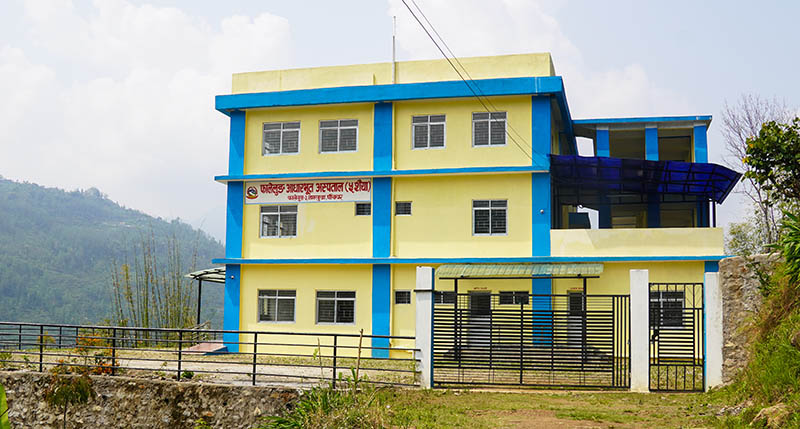
In neighboring Yangwarak Rural Municipality of Phalelung, the construction of a 15-bed basic hospital building remains incomplete. According to technician Mahabir Pun, only 65% of the work on the building has been completed.
Namunabeer JV was awarded the construction contract for NPR 147.5 million, which was 38% below the estimated cost. According to the contractor, an outstanding payment of NPR 10 million for work already completed has yet to be received. The second deadline extension granted for the building’s construction is set to expire in a few months.
In 2020, the government announced the construction of basic hospitals across 657 local units, including Phalelung and Yangwarak. On November 30, 2020, then Prime Minister KP Sharma Oli virtually laid the foundation stones from Kathmandu for 396 basic hospital buildings. Subsequently, on December 27, 2020, newly appointed Health Minister Hridayesh Tripathi decided, upon assuming office, to build basic hospitals in an additional 261 local units. The government's policy was to establish 5-, 10- and 15-bed basic hospitals in local levels lacking facilities, based on need, geography and population.
While the initiative to operate hospitals in rural areas seemed positive, the government rushed to lay foundation stones nationwide without finalizing land arrangements, feasibility studies, funding guarantees or operational plans. Consequently, construction has not even started in some locations, remains incomplete in places like Yangwarak Rural Municipality, and in areas like Phalelung where buildings have actually been completed, the hospitals remain non-functional.
According to the Ministry of Health, only 109 hospital buildings have been constructed so far. A total of 326 hospitals are currently under construction. In comparison, contracts have not even been awarded for 222 hospitals, despite assurances during the foundation-laying ceremonies that all buildings would be completed within two years.
The government had initially estimated costs of NPR 180 million (180,682,000) to construct a 15-bed hospital, NPR 108 million (108,336,000) for a 10-bed hospital, and NPR 71 million (71,197,980) for a 5-bed hospital. The total estimated budget for constructing all basic hospitals was NPR 98 billion. However, due to delayed starts and sluggish progress once construction began, costs have escalated for most of these hospital projects.
Only four buildings constructed in Karnali
In Karnali Province, which lags in health indicators, only four basic hospital buildings, the lowest number among all provinces, have been constructed. Out of the 79 local levels in Karnali, basic hospitals were announced to be built in 66 of them.
Koshi Province has the highest number of completed buildings at 24. Meanwhile, 21 basic hospital buildings have been completed in Lumbini, 19 in Bagmati, 19 in Gandaki, 12 in Madhesh and 10 in Sudurpashchim.
In Gandaki Province, the government had announced the operation of 71 basic hospitals. So far, only 19 buildings have been completed and handed over, according to Dr. Ramesh Kumar KC, Health Administrator at the Gandaki Province Ministry of Health. According to him, 10 basic hospitals have already come into operation. “Twenty-two buildings are currently under construction, while work has not been able to start in 32 locations due to land-related issues,” he said.
In Lo-Ghekar Damodarkunda Rural Municipality of Mustang, which also falls under Gandaki Province, government records show that the hospital building has already been constructed. However, the Vice Chairperson of the rural municipality, Tshering Lhamo Gurung, states that the construction is actually in its final stages. “The building will be completed very soon, but there has been no discussion so far regarding doctors and staff,” she said.
Meanwhile, in Phaktanglung Rural Municipality of Taplejung, the construction process has not even moved forward due to the non-availability of land. In Aathrai Tribeni Rural Municipality of Taplejung, construction of the hospital building did begin, but there is no sign of it being completed on time.
According to the initial contract agreement, the building was supposed to be completed by 2024. The latest extended deadline is expiring by mid-July. Santa Kumari Angbuhang, Vice Chairperson of Aathrai Tribeni Rural Municipality, said that the work is moving at a snail’s pace due to geographical remoteness and the contractor’s negligence. “Contractors take the contract and then vanish. Being a remote area, bringing construction materials is also difficult,” she added.
Vice Chairperson Santa Kumari mentioned that they will think about equipment and doctors once the building construction is finished. “However, whether doctors will even agree to come to such a remote village remains a question,” she said.
The Ministry of Health had announced the construction of a hospital in Naso Rural Municipality of Manang back in 2020. “The announcement was made, but the budget never came. We grew tired of running back and forth to the center (Kathmandu),” said Rural Municipality Chairperson Dhan Bahadur Gurung. “After that, we started looking for alternatives.”
When the central government turned a deaf ear, the rural municipality reached out to the Embassy of India in Nepal. The embassy agreed to provide a grant, and the foundation stone for the hospital was laid on May 28, 2025. “Finally, the hospital building will now be constructed,” said Rural Municipality Chairperson Dhan Bahadur.
According to Dr. Samir Adhikari, Joint Spokesperson for the Ministry of Health, NPR 6.59 billion was spent on building construction in the current fiscal year. The government had allocated NPR 11 billion in the previous Fiscal Year 2025/26.
For the Fiscal Year 2026/27, however, the government has allocated NPR 5.90 billion, less than half of the previous year’s budget. On the other hand, the goal is set to construct 336 basic hospitals over the next three years.
The budget speech mentions constructing a basic hospital in one local level per province with a low Human Development Index. However, regarding hospitals where construction has not yet started, it states that projects will proceed only after conducting scientific mapping.
According to Joint Spokesperson Dr. Samir, although budget allocations were made for hospital construction, the process has not moved forward in several locations due to various reasons. That is why the actual expenditure appears much lower than the allocated amount. There is also a provision allowing such a budget to be vired to other projects.
Dr. Samir stated that local levels began constructing hospital buildings with the expectation that the Ministry of Finance would provide the budget. Still, completion has taken time because adequate funds could not be allocated. He also explained that since basic hospital construction is a multi-year project, the entire budget is not arranged within a single fiscal year.
Bipin Bhusal, Consultant Engineer at the Policy Planning Division of the Ministry of Health, noted that difficulties in managing land according to standards have contributed to delays in building basic hospitals. “Constructing hospital buildings on riverbanks or steep slopes is not appropriate. Some local levels took time to find suitable locations,” he said.
Bibek Ghimire, Information Officer at the Ministry of Land Management, Cooperatives, Federal Affairs and General Administration, mentioned that the reasons for delays in hospital building construction vary by region. “In places where buildings haven’t been constructed, there are land disputes in some areas and procurement issues in others. However, I am unaware of any such issues being referred to our ministry,” he said. “Budget management is handled by the Health Ministry, while local levels implement it. We play a supporting role in providing mentorship, suggestions, coordination and problem resolution.”
Former Health Minister Upendra Yadav stated that during his tenure as Health Minister, a plan was prepared to establish a hospital in every local level, a health post in every ward, and a medical college with specialized services in every province. “However, subsequent governments did not pay attention to this. Ironically, those plans have not been fully implemented to date,” he said. Yadav emphasized that this plan should be pursued as a priority.
Yadav had served as Health Minister for about a year-and-a-half starting from June 2018, well before the large-scale laying of foundation stones for basic hospitals, and later assumed the post of Health Minister again in March 2024.
Foundation Stone Laid Without DPR
In 2020, when foundation stones for basic hospitals were laid across the country, detailed project reports (DPR) had not even been prepared for most of them. This demonstrates how haphazardly the then-government proceeded merely for cheap popularity.
A case in point is the basic hospital building in Tumbewa Rural Municipality of Panchthar. The DPR for that hospital is only now being approved. Rural Municipality Chairperson Baburam Khadka said, “The foundation stone for the hospital building had been laid without a DPR. Adequate land had not been arranged at that time either. We have bought land and prepared the DPR. Work will move forward now.”
Government guidelines state that 5.6 ropanis of land are required for a 5-bed hospital, while 7.2 ropanis are needed for 10-bed and 15-bed hospitals.
In Molung Rural Municipality of Okhaldhunga, laying the foundation for the hospital building has not even begun. Rural Municipality Chairperson Uttam Rai stated that technical preparations and preparing the DPR took time. “The DPR for the building has finally been prepared. It will now go into the bidding process and only after that will construction proceed,” he said. “However, I foresee securing the budget in coordination with the central government to be a challenge.”
Question on the process
Navaraj Ojha, President of the Association of District Development Committees (ADDC) / Municipal Association Gandaki, states that constructing hospital buildings is not easy. “From acquiring government land for the construction to completing various processes such as EIA, IEE, forestry approvals, and requirements of the local and health ministries, it naturally leads to delays,” he said.
Navaraj, who is also the Chairman of Rupa Rural Municipality in Kaski, shared that after hospital building construction stalled in his municipality due to procedural delays, they began operating the hospital out of a local health post instead.
Section 3 of the Environment Protection Act, 2019 mandates that an environmental study must be conducted before implementing any proposal. Meanwhile, the Environment Protection Rules, 2020 define the criteria determining whether a Brief Environmental Study (BES), Initial Environmental Examination (IEE), or Environmental Impact Assessment (EIA) is required based on the nature, scale, sensitive zone and potential environmental impacts of the project.
EIA or IEE is not compulsory for all basic hospitals. However, when constructing in forest areas, protected zones or locations with significant environmental impacts, the relevant studies and approvals are mandatory. Obtaining IEE approval typically takes two to six months, while EIA approval takes anywhere from five to 12 months or longer.
The process for providing government land required for hospital construction must comply with the Local Government Operation Act, 2017, the Lands Act, 1964, and prevailing laws regarding public and government asset management. If the proposed hospital falls within a national forest or forest area, approval from the concerned authority is mandatory under the Forest Act, 2019. Utilizing forest land may require a decision from the Cabinet or an authorized agency.
Furthermore, under the Public Procurement Act, 2007 and the Public Procurement Regulations, 2007, a Detailed Project Report (DPR) must be prepared, cost estimates approved, bids invited, and contract agreements finalized. Local officials state that completing all these steps sequentially takes six months to a year even without any disputes. They add that if issues like land disputes, forest clearances, or environmental studies arise, the timeline extends by one to two years or even longer.
Existing hospitals are somehow getting by
It has been three months since the 5-bed basic hospital came into operation in Sanokharigaon Rural Municipality of Sankhuwasabha. However, there is not a single staff member appointed against the sanctioned positions.
The hospital has only one MBBS doctor, whom the rural municipality arranged on its own. Equipment is also insufficient. Bhim Bahadur Limbu, Chairman of the rural municipality, shared that services are currently being provided by hiring health workers on a contract basis. “If we can arrange for doctors and other health personnel along with adequate equipment, many people here could benefit,” he said. “Even now, up to 700 patients visit the hospital every month.”
In Tapli Rural Municipality of Udayapur, it has been two months since the basic hospital went into operation. After the central government failed to send doctors, the municipality hired a doctor on its own to initiate services.
Rural Municipality Chairman Dhukraj BK says, “We are in discussions with the central government, but we couldn’t just wait around for the center to send doctors for the public to receive treatment. For the time being, we have hired a doctor ourselves and started the services.” He added that other human resources and equipment remain inadequate. The hospital is also preparing to bring its own pharmacy into operation.
In Buddhashanti Rural Municipality of Jhapa, nearly three years have passed since the basic hospital came into operation. Although it was announced as a 15-bed facility, only 10 beds are currently in operation due to a lack of infrastructure.
The municipality is delivering services from its own resources by deploying five MBBS doctors and one gynecologist. “Patient volume here is extremely high, but the infrastructure and workforce do not match the demand,” said Bhawani Prasad Khatiwada, Vice Chairman of the municipality. “We pleaded with the central government, but nothing came of it.”
Not only these, but manpower has not been managed according to the standards in any of the operational basic hospitals. According to the basic hospital operation standards, a 5-bed basic hospital must have one medical officer (medical superintendent), four staff nurses, three health assistants and one ayurveda assistant. Similarly, the standards specify 13 health workers, including one lab technician, one dental hygienist, one radiographer and one pharmacy assistant. There is also a provision for five administrative staff.
According to the standards, a 10-bed basic hospital must have two medical officers including a medical superintendent, five staff nurses, three health assistants and one ayurveda assistant. Likewise, there should be 15 health workers, including one lab technician, one radiographer, one dental hygienist and one pharmacy assistant. There is a provision for seven administrative staff.
In a 15-bed basic hospital, the standards mention a staff of 30 personnel, including one MDGP physician as medical superintendent, two medical officers, six staff nurses, four health assistants, as well as lab technicians, radiographers, dental hygienists, pharmacy assistants and others.
Dr. Samir, Joint Spokesperson for the Ministry of Health and Food Safety, states that the local levels themselves must manage the necessary manpower to operate basic hospitals, and doctors under the scholarship program will be deployed based on need only in municipalities facing operational difficulties. “In municipalities where the local level faces difficulty operating the hospital or is unable to manage manpower on its own, there is a provision to send specialist doctors from the scholarship program. It is not possible to send doctors from the central government to all municipalities,” he said.
According to Dr. Samir, plans for infrastructure, services and required manpower are prepared through a DPR right when hospital construction begins.
However, since creating all permanent positions during the initial phase of hospital operation is not possible, a concept of starting services using the resources available within the municipality was adopted.
Medical equipment is also not adequately arranged in basic hospitals. The Office of the Auditor General mentions the issue of equipment and manpower shortages in its report every year.
The 2025/26 report states, “It appears that hospital construction was initiated in 657 local levels under the annual program of the Government of Nepal, to provide basic healthcare services from the local level. This year, NPR 12.54 billion (12,542,546,000) was spent on hospital construction across 193 local levels, out of which 27 local levels spent NPR 2.50 billion (2,505,695,000) on hospitals where construction has been completed. Hospitals with completed buildings were not seen coming into operation due to the lack of manpower management and medical equipment.”
The 2026/27 report states, “Out of 657 basic hospitals, resource assurance of NPR 58.73 billion (58,733,352,000) was secured for 396 hospitals, while resource assurance of NPR 40.07 billion (40,074,718,000) was not secured for 261 basic hospitals. Expenditure stood at NPR 26.39 billion (26,399,000,000) for the 396 hospitals with guaranteed funding, and NPR 7.81 billion (7,811,100,000) for the 261 hospitals without guaranteed funding. Construction of 83 hospitals was completed this year. Construction work on under-construction hospitals must be completed, and manpower and equipment should be managed.”
Local levels state that basic hospitals cannot be operated without the support of the federal and provincial governments. They argue that they are unable to manage salaries and allowances for even a single MBBS doctor, limited healthcare staff, and the necessary equipment. Officials at the local level express grievance that the government hastily introduced the policy, handing over the responsibility of operating basic hospitals to local levels.
Former Health Minister Pradip Paudel stated that the current government did not even allocate the amount of budget he had allocated for hospital operation and management when he was in government.
“In our time, that is, in the Fiscal Year 2024/25, we had allocated NPR 1 billion at the rate of NPR 10 million per hospital for 100 hospitals to operate, but the subsequent government could not provide that,” he said. Emphasizing that providing basic healthcare treatment services to the public is the government’s duty, he noted that hospitals are extremely necessary in rural areas. He added, “Therefore, the government must prioritize this project.” He also commented that the current government lacks policy clarity. Paudel served as Health Minister from July 15, 2024 to September 9, 2025.
Whose responsibility is the operation?
Four years after the foundation stone was laid, the government introduced the Basic Hospital Operation Standards, 2024. By then, buildings for 57 hospitals had already been constructed.
Section 8 (1) of the standards states that full ownership and responsibility for hospital operations shall belong to the local level. Section 6 outlines the federal government’s responsibilities. Subsection 1 states, “For hospitals whose construction is completed, doctors and healthcare personnel under scholarship contracts shall be deployed by the Ministry/Department through the province based on the attached sample staff structure for manpower management.”
Subsection 2 mentions that the federal ministry may gradually provide the necessary medical equipment and supplies for hospital operations.
Section 7, Subsection 1 states that the provincial ministry overseeing health shall be responsible for enhancing the knowledge, skills and competencies of the personnel deployed for hospital operations. Subsection 2 mentions that the said ministry shall gradually provide the medical equipment and supplies required to operate the hospitals.
Similarly, Section 3 (1) specifies that arrangements shall be made to deliver basic services through coordination among the local, provincial and federal governments. However, the federal and provincial governments are not fulfilling their responsibilities according to the standards.
"Health is a basic need of citizens. If the local level cannot fulfill its responsibility, the provincial and federal governments must step in, and an environment must be ensured where no citizen is deprived of services in such a sensitive matter as health."
According to the Ministry of Health under the federal government as well, operational grants have so far been sent to only 67 local levels across various provinces for hospital operations. The operation grant was dispatched to 48 basic hospitals in the first phase and 19 in the second phase. According to the Health Ministry, an operation grant ranging from NPR 7 million to NPR 8.5 million is sent to basic hospitals based on geography, the population of that area, and the number of beds. The ministry stated that a budget has been allocated for 101 basic hospitals where building construction has been completed.
An official from the Ministry of Health stated that since a policy regarding sustainable financial management for operating basic hospitals has not yet been formulated, the federal government has continued to support local levels through operational grants even after the transfer of buildings.
What services are basic hospitals for?
Every citizen receiving free basic health services from the state is a fundamental right guaranteed by the Constitution. Article 35, Clause 1 of the Constitution also states that ‘no person shall be deprived of emergency health services.’ Clause 3 states that ‘every citizen shall have equal access to health services.’
To implement this very provision of the Constitution, the government brought forward the plan to operate basic hospitals in every municipality. The Basic Hospital Operation Standards specify that hospitals must operate by prioritizing basic healthcare services.
The standards also define the types of services basic hospitals must provide. It mentions that maternal, newborn and child health services, such as immunization services, Integrated Management of Neonatal and Childhood Illness (IMNCI), nutrition services, antenatal care, delivery and postnatal care, family planning services, abortion and reproductive health, must be provided.
Similarly, it states that communicable diseases, non-communicable diseases and physical disabilities, mental health and senior citizen healthcare services should also be provided. The standards also mention that basic hospitals shall offer general emergency healthcare services, health promotion, as well as Ayurveda and alternative medicine health services.
Former Vice Chairman of the National Planning Commission Shiva Adhikari comments that while the government’s decision to operate a hospital in every municipality is positive, the implementation side remains weak. He states that basic hospitals have been unable to function properly due to shortcomings in managing the required infrastructure.
“A hospital in every municipality is a necessity. The right of citizens to basic health services is written in the Constitution itself. The political decision to construct hospitals was also good,” said Shiva, former Vice Chairman of the Planning Commission. “However, its implementation aspect turned out to be weak. The work should have been carried out in phases.” He emphasizes that the government must complete the unfinished plans for operating basic hospitals.
Public health expert Dr. Sharad Onta also states that ensuring the right to health is the responsibility of the state. “Health is a basic need of citizens. If the local level cannot fulfill its responsibility, the provincial and federal governments must step in,” he said. “An environment must be ensured where no citizen is deprived of services in such a sensitive matter as health.”
Inadequate health facilities in rural areas
It is difficult for residents in Nepal’s rural areas even to access basic health facilities. Due to the lack of good hospitals within easy reach, they are forced to travel to distant cities. In many places, reliable transportation is also unavailable, requiring helicopter rescues in emergencies. Furthermore, treatment in cities is expensive, making it unaffordable for many given their financial status.
According to the Nepal Multiple Indicator Cluster Survey (NMICS), 2024–25, among those who received post-natal care (PNC) for newborns after birth, 83.5% received services from public health institutions. In comparison, only 15.8% went to private health institutions.
The report reveals disparities in the reach and quality of government health services. The proportion of women who were able to stay at a health facility for at least 12 hours after childbirth stands at 82% among the poor, compared to 94.3% among the rich.
The report also indicates that not all mothers and newborns have benefited from health checkups. Among women who gave birth within the last two years, only 89.5% received post-natal health checkups. For newborns, this ratio stands at 91.6%. In other words, nearly 10% of mothers and infants remain outside the reach of basic post-natal health services.
The report considers institutional delivery, the presence of skilled health personnel, and regular post-birth health checkups essential for safe motherhood. However, the data clearly shows that the government’s target of expanding quality health services down to the local level has not yet been fully achieved.
The data also suggest that delays in constructing and operating basic hospitals have concentrated the burden of primary healthcare on a limited number of government health institutions.
According to the Nepal Demographic and Health Survey (NDHS), 2022, among women who gave birth in the last two years, only 89% received post-natal care. The report notes that not all mothers received necessary health services, demonstrating that quality maternal health services have yet to be ensured down to the local level.
Full access to safe motherhood services has also not been established. According to the report, although the rate of deliveries conducted in health facilities in the presence of skilled birth attendants has increased, not all women have received institutional delivery services. The report highlights the need for continuous expansion of access to services ranging from pregnancy to delivery and post-natal care.
Progress on family planning, another crucial indicator of primary healthcare, also appears to have stalled. Currently, while 57% of married women use some form of contraception, the proportion using modern methods remains limited at 43%. The report shows that there has been no significant increase in the use of modern contraceptives from 2011 to 2022. This raises questions about the effectiveness of reproductive health services down to the local level.
Adolescent pregnancy also remains a challenge for the healthcare system. According to the report, 13.6% of teenage girls aged 15 to 19 have been pregnant. This rate stands at 20.5% in Karnali and 19.8% in Madhesh. Among teenage girls with no formal education, 32.7% have been pregnant. The report indicates that the issue of teenage motherhood is even more severe in areas with weak access to education and health services.
Both reports demonstrate the necessity and justification for basic hospitals to address such health issues.
According to the Economic Survey 2025/26 published by the government, 8,976 health institutions are currently operational under the government sector. Among them, there are 420 hospitals and 181 primary health centers. Likewise, there are 3,603 health posts, 426 Ayurvedic dispensaries, and 4,346 sub-health posts and basic health service centers.
Active in healthcare service delivery are 384 ayurveda assistants, 693 ayurvedic physicians, 16,313 health assistants, and 51,386 female community health volunteers (FCHVs).
Cover photo: Under-construction basic hospital building in Tharpu, Yangwarak Rural Municipality. Photo: Giriraj Banskota/NIMJN
Please adhere to our republishing policy if you'd like to republish this story. You can find the guidelines here.
Comments