
Historical heritage sites, including traditional rest houses (Pati, Pauwa), community wells (Kuwa), stone spouts (Dhunge Dhara), and temples, are being destroyed during the expansion of the Suryabinayak-Dhulikhel road.
Fifty-two-year-old Rajukumar Madhikarmi Shrestha of Bhainsepati, Banepa Municipality-13, spent his childhood drinking from a well near his home. He would visit the well every morning, not just to fetch drinking water, but also to bathe and wash clothes. “The water in that well was clean and plentiful,” Rajukumar recalls. “But that well is gone now. The site has been bulldozed.”

The well was demolished during the expansion of the Suryabinayak-Dhulikhel section of the Araniko Highway. Since then, local residents, including Rajukumar, have faced water shortages.
“Claiming it fell within the 75-meter road boundary, the Department of Roads demolished three of our 200-year-old historic wells,” says Rajukumar. “Water is now seeping away and going to waste, while the village remains parched.”
Conservationists have expressed deep concern over the damage to historical heritage as the Suryabinayak-Dhulikhel road, a primary gateway to the Kathmandu Valley, is transformed into a modern six-lane expressway. Heritage activist Bhishan Madhikarmi Shrestha explains that history and heritage are being buried as the 15.8-kilometer two-lane stretch is widened. According to him, this area is rich in Newari settlements, Malla-era houses, ancient temples, traditional rest houses (Pati-Pauwa, Falcha), and stone spouts (Hiti). “Heritage sites were neglected during the expansion, leading to their destruction,” he says. “The preservation of cultural heritage is just as important as development.”
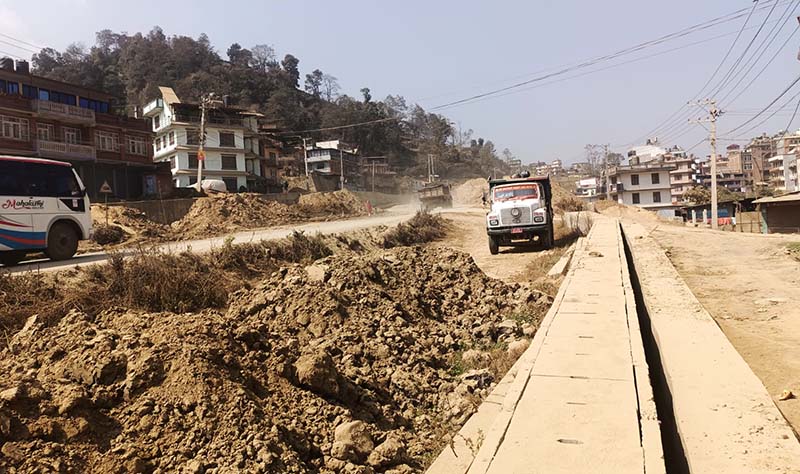
According to conservationist Shrikrishna Dhimal, stone spouts have been buried during this road expansion. Some have been relocated and reconstructed using cement, while small rest houses (Patis) now lie beneath drainage ditches, actions he claims violate the Ancient Monument Preservation Act, 2013. There are clear standards for protecting historical heritage such as Patis, Pauwas, wells, stone spouts, and temples when they fall within road expansion zones. According to the Ancient Monument Preservation Act, 2013, and UNESCO World Heritage Centre international standards, heritage must be preserved while maintaining its originality.
However, no conservation efforts were made during this road expansion. A Heritage Impact Assessment (HIA) preliminary report showed that 35 historical stone spouts, rest houses, wells, Falchas, Hitis, Rana-era checkpoints and temples in the Banepa, Janagal, Bhainsepati, Sanga and Palanse areas are at risk.
Furthermore, 12 heritage sites have already been damaged, including the well in Bhainsepati. The destruction of this well has caused a severe water crisis in the area. “Those of us whose wells have run dry are now borrowing water from neighbors,” says Rajukumar. “When ward boundaries were drawn, the neighboring ward refused to share water and the road project buried our own village’s source.”
According to him, that well was not just a water source. It was a community resource used for centuries. Records indicate the well was dug during the reign of Juddha Shumsher for travelers and local residents.
The Department of Roads viewed the well and surrounding heritage as obstacles and subsequently used bulldozers to erase their existence. Raju Madhikarmi Shrestha notes that instead of protecting the wells, the decision to simply remove them shows the project’s lack of sensitivity toward heritage.
Another historical stone spout (Hiti) in the western part of Bhainsepati was also demolished during the expansion. Local residents say that instead of restoring the Hiti, which had already begun to dry up, it was completely removed.
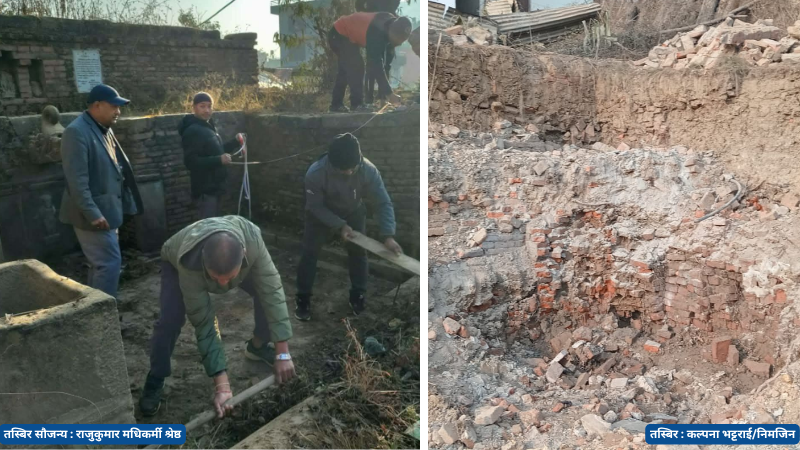
Architectural engineer Sanjok Adhikari points out that the problem stems from a tendency to view heritage as obstacles rather than structures to be preserved during road design. “The Department of Roads brought in bulldozers directly without coordinating with the Department of Archaeology,” he says. “Wells and stone spouts are not just stone structures, they are vital examples of ancient water management systems.”
However, Ramlal Duwal, the Ward Chairman of Banepa Municipality-13, claims that the process of relocating the wells and stone spouts to build new taps was moved forward with local consent. According to him, the decision to relocate them was made as an alternative after realizing the structures falling along the roadside could not be saved. Yet, this process appears to violate the Ancient Monument Preservation Act, 2013. According to the Act, historical structures cannot be relocated from their original sites. Even in cases of damage, the law mandates they be reconstructed in their original form at the same location. Ignoring this, the road project reached an agreement to build new taps after demolishing the wells.
Vijay Kumar Mahato, chief of the Suryabinayak-Dhulikhel Road Project, asserts that the structures were removed with the consent of local residents and the ward office. Meanwhile, the ancient bricks, stones, soil and artistic idols of crocodiles, Bhairav, and Ganesh used in the demolished stone spouts and wells now lie abandoned. There is no evidence of the local government taking steps to protect them.
According to the Department of Archaeology, the Department of Roads carried out the work without necessary coordination. Sandip Khanal, an archaeology officer at the Heritage Conservation Branch, says, “The Department of Roads used bulldozers to demolish the structures without any agreement from the Department of Archaeology.”
Road excavation began even before the project’s preliminary Heritage Impact Assessment (HIA) report was prepared. The Department of Archaeology only produced the report following pressure from conservationists. Heritage activist Shrikrishna Dhimal notes that the wells and stone spouts were demolished during construction that took place before the report was even released.
Conflict between faith and development
The expansion of the Suryabinayak-Dhulikhel road has brought the conflict between development and heritage conservation to the surface. The project’s preliminary Heritage Impact Assessment (HIA) report mentions that numerous historical structures in Bhainsepati, Janagal, Sanga and Banepa are at risk, noting the destruction of temples and wells of historical and religious significance. Notably, the Siddhi Vinayak temple in Bhainsepati, which was considered non-relocatable, has been moved.
According to Purushottam Acharya, a museum officer at the Department of Archaeology, instructions have been issued to reconstruct historical heritage sites, including stone spouts, in accordance with the Ancient Monument Preservation Act, 2013 (Fifth Amendment), and to submit progress reports to the department.
The project office has stated that there are difficulties in managing eight historical structures within the 8.4 km section of the Suryabinayak-Dhulikhel road. The pond, temple, well, Nasika temple and stone spout in Sanga, as well as the wells, stone spouts, Ganesh temple, Mahadev temple and ritual ponds (Kunda) in the Bhainsepati and Janagal areas, remain at risk. Among these, the Ganesh temple and three stone spouts have already been relocated. Project Chief Vijay Kumar says that work on the remaining eight heritage sites across seven locations will proceed after preparing alternative designs for conservation, management or relocation and discussing them with local residents.
He admitted that some heritage sites were damaged during road construction. According to him, approximately 90 structures, including Patis, Pauwas, stone spouts, Falchas and wells, fall within the road’s boundaries. “Because road excavation began without an initial archaeological study, some structures were damaged,” Project Chief Vijay Kumar says. “That was our mistake.”
According to him, about 66% of the work has been completed so far, and the project deadline has been extended to November 2026. He also mentioned that the design was modified to save certain structures during the expansion. “To protect the Nasika Temple in Sanga, we have limited the road to five lanes in that section,” he said.
Due to the tendency to view heritage as an obstacle during road design, the Vasuki Pond in Sanga is at risk of being destroyed. After the road expansion encroached upon 20% of its area, the water balance was disrupted. Manoj Shrestha of Sanga states that the danger of the pond drying up has increased. In Janagal, rest houses (Patis) and stone spouts have been demolished, with only ruins remaining for some. He claims that for many sites, the original identity has been erased along with their relocation.
The Damai Pati in Bhainsepati was a place where locals would rest their heavy loads, gather and hold discussions. Now, it is limited only to its foundation. The project’s preliminary Heritage Impact Assessment (HIA) report also recognized this as a significant heritage site. Heritage activist Bhishan argues that the failure to save these sites highlights the weaknesses of the local government and the Department of Archaeology, which bears the responsibility for conservation.
While some heritage sites have been saved due to pressure from local residents and conservationists, the presence of the Department of Archaeology appears weak. However, the department maintains that it has repeatedly requested coordination. “We have sent several letters requesting the road be built while preserving heritage sites in their original locations but there has been no response from the Department of Roads,” says Sandip Khanal, an archaeology officer at the Department of Archaeology. He mentioned that after the Nasika Bhagwati Temple, the department is now working to save the Hiti (stone spout) and Falcha (rest house) in Bhaktapur.
Based on the HIA report and letters sent by the Department of Archaeology to the road project, the municipality and the administration office, it was recommended that the road route be diverted to save the ancient stone spouts, rest houses and ponds in the Banepa and Sanga areas. In a letter written to Banepa Municipality on June 18, 2023, the Department of Archaeology instructed that the road be diverted to protect the historical structures at Falcha Hiti in Banepa-14, where ancient bricks and black soil (Kalimati) were discovered.
On January 31, 2026, the Department of Archaeology sent a letter to the Suryabinayak-Dhulikhel Road Project, expressing strong objections to the damage caused to the Nasika Temple in Sanga and archaeological sites in the Bhainsepati area. In another letter dated January 16, 2025, the department ordered the project to use only traditional materials and no cement when reconstructing the damaged structures.
Heritage sites such as the historical Hiti in Pulbazar, Rana-era rest houses (Sattal), the Bhainsepati well, Vasuki Pond, Bachamari Falcha and the Nasika Bhagwati Temple complexare under direct threat. Archaeology Officer Sandip says, “We have issued instructions to work according to the Ancient Monument Preservation Act. There should be no compromise on diverting the road route to save the water sources of the stone spouts and the originality of the rest houses.”
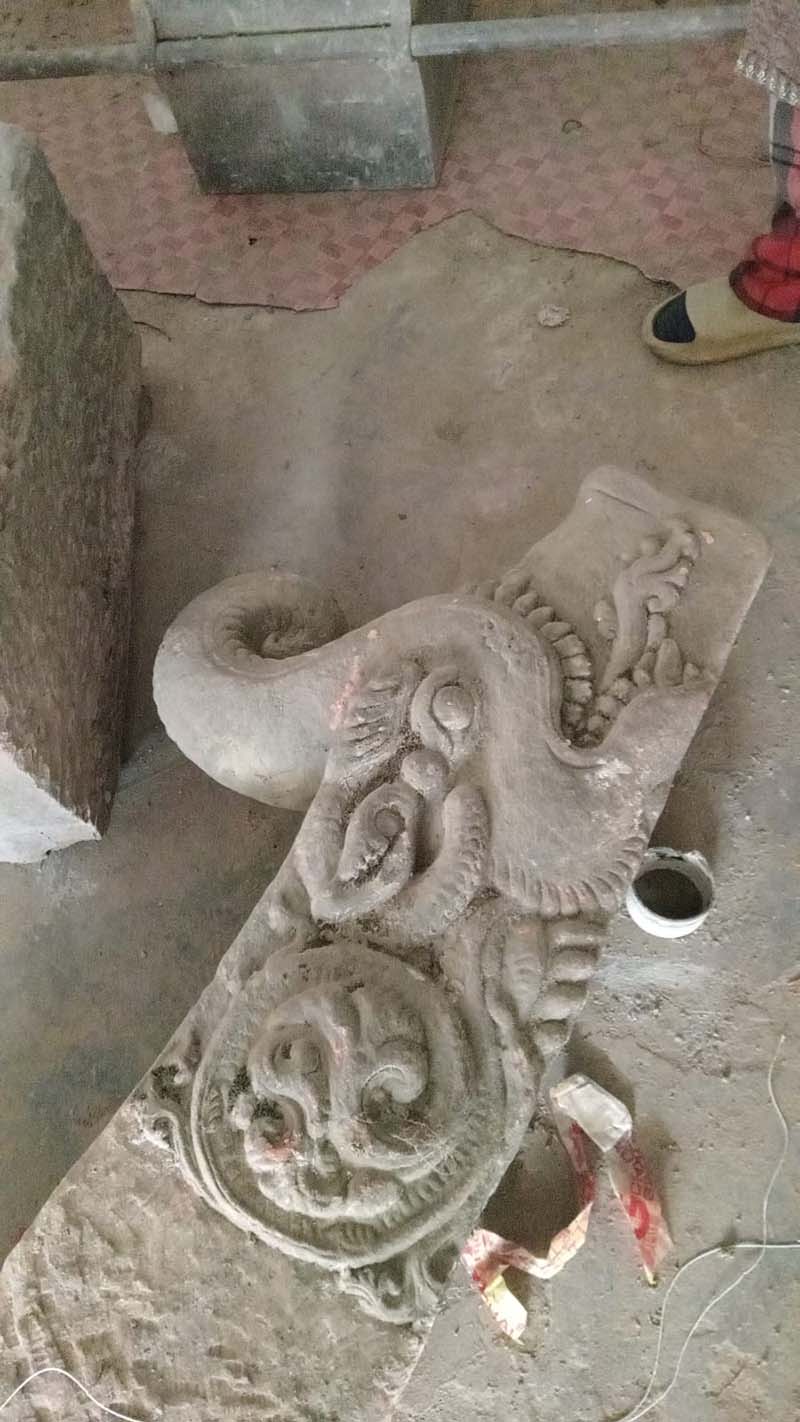
Photo courtesy: Shrikrishna Dhimal.
Although the department initially used strong language in its letters, stating ‘do not proceed with construction’, it later appears to have given ‘conditional consent’. Conservationist Shrikrishna Dhimal states, “The Bachamari Falcha might be movable but the water source cannot be moved. Sources are underground. Telling someone to move a source 10 meters away is against the rules.” He alleges that the department, under pressure from the National Pride Project, granted permission to move the water source itself.
The report indicates that the impact goes beyond physical structures, affecting cultural traditions such as Banepa’s traditional funeral routes, Navadurga dance and the Yaasin festival. According to heritage conservationist and historian Prof. Dr. Mahesh Raj Pant, while the road expansion will ease traffic flow, the risk of erasing identity and history is equally high.
Rather than technical debates over how many meters to shift the road, the primary need now is to revise the design with historical and cultural values at the center. He says, “This is not an opposition to development but we should not erase the stone spouts and rest houses built by our ancestors to make a six-lane road. Other countries have expanded roads while saving their heritage. We can do the same.”
Water sources and heritage could have been saved by slightly diverting the road or narrowing it, but those alternatives were not adopted. According to heritage conservationist Sunil Prajapati, such damage could have been avoided if heritage had been integrated into the project from the very beginning. He says, “While prioritizing development, no attention was paid to conservation.”
The Department of Archaeology intervened midway by issuing a circular to stop bulldozers in the Bhainsepati area. According to the then-archaeology officer Bhishma Baskota, instructions were given to halt work after ancient bricks, water sources and other archaeological materials were discovered. However, those directives were not effectively implemented.
Is heritage more important than development?
International standards have been established to ensure the conservation of cultural heritage alongside development. These standards mandate an assessment of the impact on heritage before any development work begins. The UNESCO World Heritage Centre’s concept of the Historic Urban Landscape, which encompasses the integrated form of an old city’s heritage, culture and environment, emphasizes the need to maintain cultural and environmental balance when developing historic cities.
In response to a writ petition regarding the impact on heritage and the environment during the construction of the Kalanki-Thankot-Nagdhunga road in Kathmandu, the Supreme Court issued a mandamus on September 18, 2017. The court ordered that development projects and construction be carried out by keeping the protection of archaeological sites of environmental and natural importance at the center. In practice, however, court orders, laws and standards appear to be ignored.
Stone spouts (Hiti) and wells are not just water sources. They are living examples of traditional water management systems. Developed at a time when modern technology did not exist, these systems represent the knowledge and skills of managing water according to the local environment. Historian Prof. Dr. Mahesh Raj Pant says, “The disappearance of these structures is not just the loss of stone or brick. It is the loss of our history, knowledge and identity.”
The destruction of such structures directly affects water sources. According to Manoj Shrestha, water sources that have existed for centuries are now on the verge of drying up. “Stone spouts and wells are not just places to collect water. They are places where local residents meet and connect,” says heritage activist Bhishan.
Similarly, Patis and Falchas served as places for local residents to rest their loads and socialize. The loss of structures like the Damai Pati in Janagal is seen as weakening the social harmony among locals. He adds that these heritage sites are also significant from a cultural perspective, as these very structures define the identity of a historic city.
Was conservation possible alongside development?
According to architectural engineer Sanjok Adhikari, while an Environmental Impact Assessment (EIA) was conducted during the preparation of the Detailed Project Report (DPR) before the road expansion, a Heritage Impact Assessment (HIA) to study the impact on heritage was not. He believes this was a major oversight.
“The impact on historical and archaeological structures was simply not considered during the road design,” he says. “If an HIA had been conducted from the start, structures such as wells, stone spouts, Patis, Falchas and temples could have been saved.”
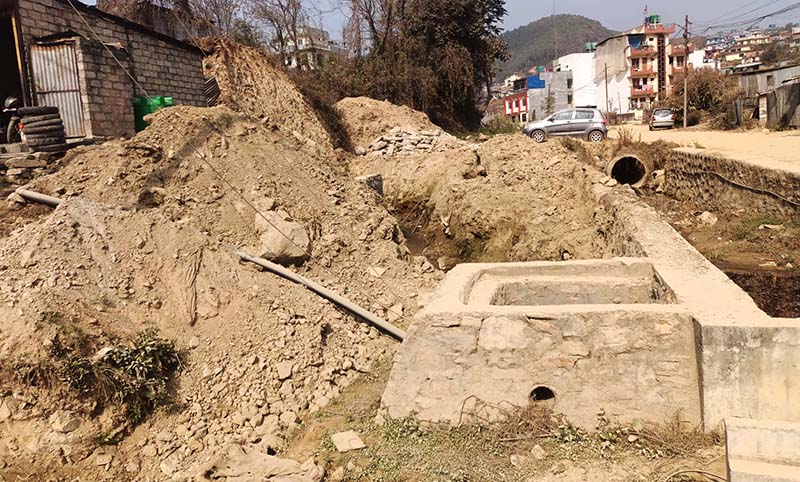
It was only after the bulldozers began their work during the road expansion that wells and stone spouts started being uncovered in various locations. However, conservation efforts were not effective. According to Sanjok, old structures were viewed as obstacles in the name of development. “We should have reconstructed the old structures while preserving their original character,” Sanjok says. “Instead, by building new ones, the historical art and form have been lost.”
Sanjok explains that options to save the heritage were available during the road design phase. It would have been possible to slightly curve the road, adjust the width, or preserve the structures within islands. Similar practices were followed during road construction around the Sinamangal, Mahankal and Bhadrakali temples in Kathmandu. “That same method could have been adopted here,” he says. “Moving some structures into the middle of settlements is not a correct practice.”
Structural engineer Prof. Rajan Suwal agrees with his view. According to him, the notion that a road must always be straight is incorrect. “If heritage blocks the path in some places, the road can be built by curving it,” he says. “If necessary, the road can be managed by dividing it into segments.” He suggests that heritage could have been saved by making the road two lanes in some places and four lanes in others.
He stated that technology could also have been used to save the water sources. “Concreting should not be done where there is a natural spring. Instead, pipes or culverts can be used to preserve the natural flow of water. If the outlet is blocked, it creates another major problem,” Rajan says.
According to conservationists, relocating archaeological structures is not a long-term solution. Preservation should happen exactly where the structure stands. However, this does not seem to be the case in practice. In many places, structures have been removed and reconstructed in new forms using cement, which has weakened their authenticity. “There must be a balance between development and conservation,” says Prof. Rajan. “That is why the road should be moved but the heritage should not.” He adds that while this 50-meter wide, six-lane road project might manage traffic, it will result in the loss of its original identity.
Cover Photo - A falcha near Palanse, Bhaktapur, which was relocated during the road expansion. Photo: Kalpana Bhattarai/NIMJN
Please adhere to our republishing policy if you'd like to republish this story. You can find the guidelines here.

Comments